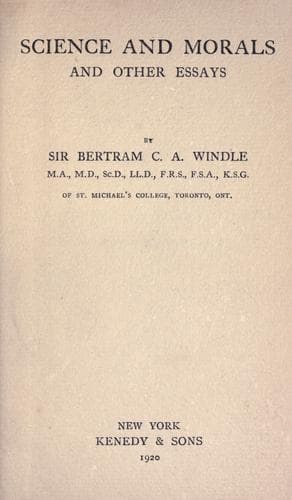
Science and Morals and Other EssaysWindle, Bertram Coghill Alan, Sir
Religion
Science and Morals and Other Essays
Windle, Bertram Coghill Alan, Sir
Essays; Religion and science; Science
Professor Conklyn, an American enthusiast for extreme eugenistic views,
has also set down in print his ideas as to the lines on which our lives
are to be run under a scientific domination, and these are to be dealt
with in another article.[20] His scheme entails a forcible visit, not,
it may be supposed, to the Altar, but to the Registry Office, for all
persons held to be fit to perpetuate the race, and forcible restraint,
whether by imprisonment or by sterilisation, for all others.
The first thing which all these essays towards a scientific conduct of
life reveal is a total want of perspective, for they proceed on the
hypothesis--which no doubt their authors would defend--that this world
and its concerns are everything, and that the intellectual and physical
improvement of the human race by any measures, however harsh, is the
"one thing needful." But beyond this the persons who hold such views
seem to have entirely overlooked the fact that their proposed State
would be one conducted on principles of the bitterest and most galling
slavery imaginable by the mind of man, a form of slavery that never
could persist if for a moment it be conceded that it could ever come
into operation. The fact is that the whole thing is ludicrous when
looked at from the point of view of common sense, but how few take the
trouble to contemplate these schemes as they would be in operation! Were
they thus to contemplate them, they would see that, apart altogether
from any religious considerations, they are wholly impossible, even from
a purely political point of view. That such ideas are intolerable to
Catholic minds, indeed to any Christian mind, goes without saying.
Driesch (_Science and Philosophy of the Organism_, vol. ii., p. 358) has
pointed out very clearly that "the mechanical theory of life is
incompatible with morality," and that it is impossible to feel "morally"
towards other individuals if one knows that they are machines and
nothing more. Again, Professor Henslow (in _Present Day Rationalism
Critically Examined_, p. 253) very pertinently asks those who discard
all religious considerations and claim to rely for guidance on the
lessons of Nature, "If you have no taste for virtue, why be virtuous at
all, so long as you do not violate the laws of the land?"
Public-domain text, read in full here on John Shaqi.
Reviews
Reviews
No reviews yet
Be the first to share your thoughts on this work.
Join the Discussion
Join the discussion
Sign in to leave a comment or review.
Sign InorCreate an account