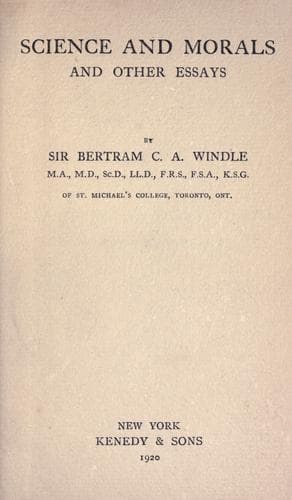
Science and Morals and Other EssaysWindle, Bertram Coghill Alan, Sir
Religion
Science and Morals and Other Essays
Windle, Bertram Coghill Alan, Sir
Essays; Religion and science; Science
_Initium sapientiae timor Domini_; no doubt, but such fear is only the
beginning, and is not the kind of fear--which also exists--a fear which
engenders an actual revulsion against the idea of God.
It is to this kind of fear which the eminent Jesuit writer Wasmann
alludes when he says that "in many scientific circles there is an
absolute _Theophobia_, a dread of the Creator. I can only regret this,"
he continues, "because I believe that it is due chiefly to a defective
knowledge of Christian philosophy and theology."
That he is entirely right as to the existence of this feeling there can
be no doubt; no one can read at all widely in scientific literature
without becoming aware of it. Contrary to all the tenets of science
there is even a bias against any such idea as that of a Creator, though
science is supposed to confront all problems without bias of any kind. I
need not cite instances of this feeling; I have dealt with it elsewhere.
We may take it for granted, and proceed to look for an explanation for
the phenomenon. Wasmann attributes it to ignorance, and he is, I feel
sure, right; but let us examine the matter a little more closely. Why
should persons--even if ignorant--have the bias which some obviously
present against the idea of a God? Why should they wish to think that
there is no such Being, no future existence, nothing higher than Nature?
Some persons maintain that precedent to a denial of God there must be a
moral failure. That I am sure is quite wrong. I should be far from
saying that in some materialists there is not a considerable weakening
of moral fibre, or perhaps it would be better put, a distortion of moral
vision, as evidenced by many of the statements and proposals of
eugenists, for example, and by the political nostrums of some who wrest
science to a purpose for which it was not intended. This no doubt is
true, but it is not quite the argument with which I am now dealing, and
that argument, if it implies moral failure in the persons concerned, has
little if any genuine foundation in fact. Mr. Devas, in that very
remarkable book, _The Key to the World's Progress_, gives us the useful
phrase "post-Christians." These people are really pagans living in the
Christian era, retaining many of the excellent qualities which they owe
neither to Nature nor to paganism, but to the inheritance--perhaps
involuntary and unrecognised--of the influences of Christianity. Many of
these people are kind, benevolent, scrupulously moral. They have not
learned to be such from Nature, for Nature teaches no such lessons. Nor
have they learnt them from paganism, for these are not pagan virtues.
They are an inheritance from Christianity. Those, therefore, who build
arguments as to the needlessness of religion on the foundation that
persons without any belief in God do exhibit all the moral virtues,
build on sand. At any rate the answer to the question which we are
discussing is not to be found in this direction.
Public-domain text, read in full here on John Shaqi.
Reviews
Reviews
No reviews yet
Be the first to share your thoughts on this work.
Join the Discussion
Join the discussion
Sign in to leave a comment or review.
Sign InorCreate an account