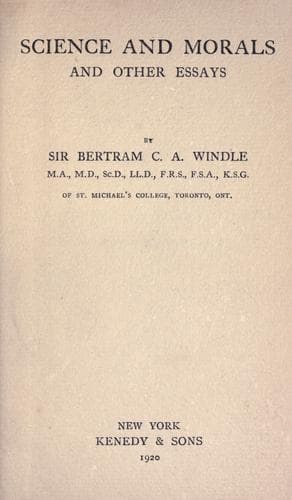
Science and Morals and Other EssaysWindle, Bertram Coghill Alan, Sir
Religion
Science and Morals and Other Essays
Windle, Bertram Coghill Alan, Sir
Essays; Religion and science; Science
Others again will perhaps maintain the thesis that fashion has a great
deal to do with this. It is not fashionable to believe in God, or at
least it was not. It was highly fashionable to call oneself an agnostic;
perhaps it is not quite so much the vogue now as it was. No doubt there
is something in this, though not very much. It is much easier to go with
the tide than against it, and there are scientific tides as truly as
there are tides in the fashion of dress. There was a Weismann tide, now
nearly at dead water; there was an anti-vitalistic tide, now ebbing
fast. When these were in full flow it was a hazardous thing for a young
man who had to make his own way in the scientific world to swim against
either or both of them. Fashions change, and fashion is not so set
against the idea of a God as it was. The materialistic tide is "going
out," and we shall see that there is some truth in the view which holds
that the incoming tide is largely that of occultism, a thing disliked
and despised--and indeed with some reason--by the materialistic school
even more than it dislikes and despises theistic opinions.
Fashion, however, is not in any way a complete answer to the question we
are proposing to ourselves, nor is the unquestionable fact that
scientific men have a strong objection to putting their trust in
anything which cannot be subjected either to scientific examination or
to experiment. In this attitude there is more than a germ of truth.
"Occam's razor" is as valuable an implement to-day as it ever was, and
everyone will admit that we must exhaust all known causes before we
proceed to postulate a new one.
We have gone beyond the day of the absurd statement that thought (which
is of course unextended) is as much a secretion of the brain as bile
(which, equally of course, is extended) is of the liver. No one nowadays
would commit himself to such a statement, and men in general would be
chary of urging that we should not believe anything which we cannot
understand. I have myself heard a distinguished man of science of his
day--he is dead this quarter of a century--make that statement in
public, wholly ignoring the fact that any branch of science which we may
pursue will supply us with a hundred problems we can neither understand
nor explain, yet the factors of which we are bound to admit. But there
is undoubtedly a dislike to accepting anything which cannot be proved by
scientific means, and a tendency to describe as "mysticism"--a terrible
and damning term to apply to anything, so its employers think!--any
explanation which postulates something more in the universe than
operations of a physical and chemical character.
Public-domain text, read in full here on John Shaqi.
Reviews
Reviews
No reviews yet
Be the first to share your thoughts on this work.
Join the Discussion
Join the discussion
Sign in to leave a comment or review.
Sign InorCreate an account