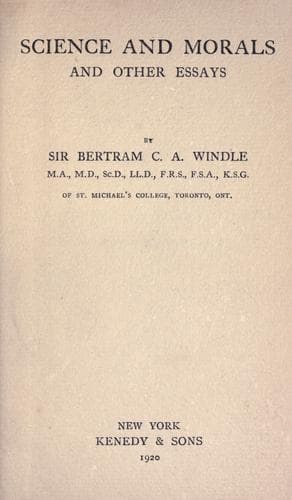
Science and Morals and Other EssaysWindle, Bertram Coghill Alan, Sir
Religion
Science and Morals and Other Essays
Windle, Bertram Coghill Alan, Sir
Essays; Religion and science; Science
During the three years immediately preceding the war we had excellent
examples of all these things. In the first of them we were treated to a
somewhat belated utterance in opposition to Vitalism. Its arguments were
mostly based upon what even to the tyro in chemistry seemed to be rather
shaky foundations. Such indeed they proved to be, since the deductions
drawn from the behaviour of colloids and from Leduc's pretty toys were
promptly disclaimed by leading chemists in the course of the few days
after the delivery of the address.
Further, the President for the year 1914 in his address (Melbourne, p.
18)[1] told us that the problem of the origin of life, which, let us
remind ourselves, in the 1912 address was on the point of solution,
"still stands outside the range of scientific investigation," and that
when the spontaneous formation of formaldehyde is talked of as a first
step in that direction he is reminded of nothing so much as of Harry
Lauder, in the character of a schoolboy, "pulling his treasures from his
pocket--'That's a wassher--for makkin motor-cars!'" Nineteen hundred and
twelve pinned its faith on matter and nothing else; Nineteen hundred and
thirteen assured us that "occurrences now regarded as occult can be
examined and reduced to order by the methods of science carefully and
persistently applied."[2] Further, the examination of those facts had
convinced the deliverer of the address "that memory and affection are
not limited to that association with matter by which alone they can
manifest themselves here and now, and that personality persists beyond
bodily death." Nineteen hundred and fourteen proclaimed telepathy a
"harmless toy," which, with necromancy, has taken the place of
"eschatology and the inculcation of a ferocious moral code." And yet it
is on telepathy, if we are to believe the daily papers, that Sir Oliver
Lodge largely relies for his proofs. Here, at any rate, is a pleasing
diversity of opinion which fully bears out what was said at the
beginning of this paper. It is, however, with the third address, or
rather pair of addresses, that we are concerned; for the meeting of
1914, not only was the first to be held at the Antipodes, but also the
first to be honoured with two addresses--one in Melbourne, the other in
Sydney.
Public-domain text, read in full here on John Shaqi.
Reviews
Reviews
No reviews yet
Be the first to share your thoughts on this work.
Join the Discussion
Join the discussion
Sign in to leave a comment or review.
Sign InorCreate an account