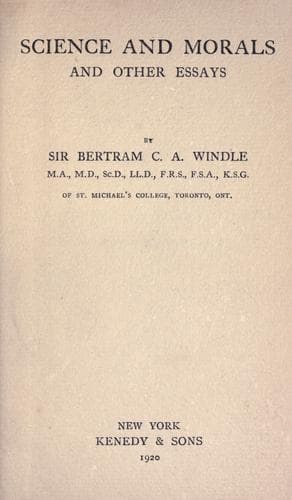
Science and Morals and Other EssaysWindle, Bertram Coghill Alan, Sir
Religion
Science and Morals and Other Essays
Windle, Bertram Coghill Alan, Sir
Essays; Religion and science; Science
Their deliverer is a very distinguished and a very independent man of
Science. It was he who insisted, at a time when the domination of a very
rigid form of Darwinism was much stronger than it is to-day, that the
picture of Nature as seen by us is a Discontinuous picture, though
Discontinuity does not exist in the environment. And it was he who asked
whether the Discontinuity might not be in the living thing itself, and
prefixed to the monumental work[3] in which he discussed this question
the significant text from the Bible: "All flesh is not the same flesh;
but there is one kind of flesh of men, another flesh of beasts, another
of fishes, and another of birds." Nearer to our own times, he was one of
a small body of men of science who almost synchronously disinterred the
forgotten works of Abbot Mendel, and proclaimed them to the world, as
containing discoveries of the first value. He was thus always something
of a "Herald of Revolt," and maintains that character in these
addresses. "We go to Darwin for his incomparable collection of facts. We
would fain emulate his scholarship, his width and his power of
exposition, but to us he speaks no more with philosophical authority. We
read his scheme of evolution as we would those of Lucretius or Lamarck,
delighting in their simplicity and their courage" (M., p. 9).
"Naturally, we turn aside from generalities. It is no time to discuss
the origin of the Mollusca or of Dicotyledons, while we are not even
sure how it came to pass that _Primula obconica_ has in twenty-five
years produced its abundant new forms almost under our eyes" (_ib._,
_ib._). And so on. To take one other example: there is nothing which was
more insisted upon by Darwinians than the fact that all the various
races of domestic fowl known to us came from _Gallus bankiva_, the
jungle-fowl of India; in fact I think I have seen that form enthroned
amongst its supposed descendants in more than one museum. "So we are
taught; but try to reconstruct the steps in their evolution and you
realise your hopeless ignorance" (M., p. 11). If we cannot construct a
"tree" for fowls, how absurd to adventure into the deeper recesses of
Phylogeny. If all that Professor Bateson says is true, is not Driesch
right when he speaks of "the phantasy christened Phylogeny"?[4]
The addresses, however, were not solely concerned with throwing contempt
upon views which were yesterday of great respectability, and which even
to-day are as gospel to many. They devoted themselves chiefly to the
consideration of the question of heredity, viewed, as might be expected,
from the Mendelian standpoint.
Now, at this point it may be said that there are at least two things
which we should like to know about heredity--the vehicle and the laws.
It is clear that we might know something, perhaps even a good deal,
about one of these without knowing anything about the other.
Public-domain text, read in full here on John Shaqi.
Reviews
Reviews
No reviews yet
Be the first to share your thoughts on this work.
Join the Discussion
Join the discussion
Sign in to leave a comment or review.
Sign InorCreate an account