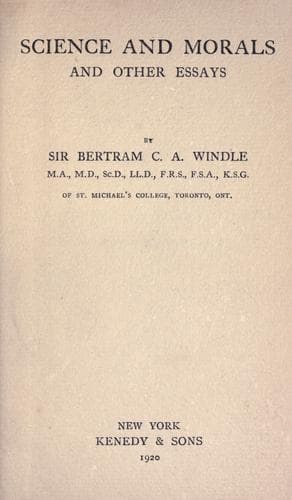
Science and Morals and Other EssaysWindle, Bertram Coghill Alan, Sir
Religion
Science and Morals and Other Essays
Windle, Bertram Coghill Alan, Sir
Essays; Religion and science; Science
lasting at least an hour and a quarter--on services in church; one,
sometimes two, hours of Sunday School; no books but those of a religious
character; no amusements of any kind even for the very young, unless the
putting together of a dissected map of Palestine could be called an
amusement; what a method of rendering Sunday attractive to the young!
Is it any wonder that those brought up on such a plan abandoned, with a
sigh of relief, all religious exercises when at last they were able to
do so? I notice that Mr. Belfort Bax, in his _Reminiscences of a Mid and
Late Victorian_, alludes to this matter, saying that, "The most cruel of
all the results of mid-Victorian religion was, perhaps, the rigid
enforcement of the most drastic Sabbatarianism. The horror of the tedium
of Sunday infected more or less the whole of the latter portion of the
week." _Experto crede!_ He says further, dealing with the 'fifties, that
"the intellectual possibilities of the English people were then stunted
and cramped by the influence of the dogmatic Calvinistic theology which
was the basis of its traditional sentiment;"--it is exactly the point
which I am trying to make.
We may now examine two instances of the kind of teaching with which I am
dealing and its results. The first is that of the poet Cowper, and
anyone who takes the trouble to read his life as written by Southey will
find the whole piteous tale fully drawn out. Southey hated the Catholic
Church, of which, by the way, he knew absolutely nothing, but he had
sufficient sense to reject the teachings of Calvinism. Cowper was at
times insane and at other times of anything but a well-balanced mind,
and he was just the kind of man who never ought to have been brought
under the influences to which he was subjected. His principal adviser
was the Rev. John Newton, a well-known Calvinistic clergyman of the
Church of England. He must have been a man of compelling character, for
he it was who brought the Rev. Thomas Scott, Rector of Aston Sandford,
out of Socinianism, which, though a minister of the Church of England,
he professed, into the Calvinistic view of things, as Scott himself
tells us in his book _The Force of Truth_; and it must not be forgotten
that it was to the writings of this same Scott that Newman tells us (in
his _Apologia_) that he owed his very soul. Newton, like many of his
fellows, had no sort of doubt as to his right to act as a director of
souls, nor of his profound knowledge of how they should be dealt with.
Yet it is to be remembered that, whilst the Catholic priest is obliged
to undergo a long and careful training before he is permitted to take up
this perilous task, Newton and those of his kind undertook it without
any training whatever. Cowper, as everybody knows, was carefully and
kindly tended by Mrs. Unwin, a woman a good deal older than himself,
against whose character no word of reproach was ever uttered, the widow
of an old friend of the poet. Newton wanted to drive Mrs. Unwin out of
Public-domain text, read in full here on John Shaqi.
Reviews
Reviews
No reviews yet
Be the first to share your thoughts on this work.
Join the Discussion
Join the discussion
Sign in to leave a comment or review.
Sign InorCreate an account