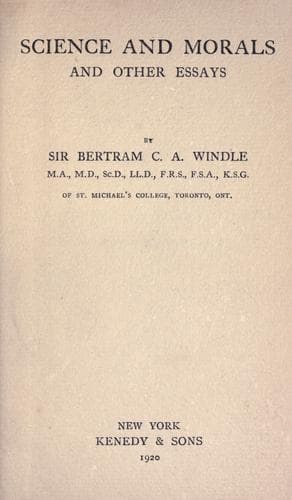
Science and Morals and Other EssaysWindle, Bertram Coghill Alan, Sir
Religion
Science and Morals and Other Essays
Windle, Bertram Coghill Alan, Sir
Essays; Religion and science; Science
his house, but here at least Cowper rebelled and showed his very just
annoyance, Newton actually urged Cowper to abandon the task of
translating Homer, a labour undertaken to distract his poor sick mind
from thinking of itself, because such work, not being of a religious
character, partook of the nature of sin. It is no wonder that such a
rule of life had not infrequently the most distressing consequences.
Newton himself admits that his preaching had the reputation of driving
people into lunacy. In a letter asking that steps may be taken to remove
one poor victim to an asylum he says: "I hope the poor girl is not
without some concern for her soul; and, indeed, I believe a concern of
this kind was the beginning of her disorder. I believe," he continues,
"my name is up about the county for preaching people mad ... whatever
may be the immediate cause, I suppose we have near a dozen, in different
degrees, disordered in their heads, and most of them I believe truly
gracious people."
Let us turn to the other example which I propose to select, that given
by Mr. Gosse in his truly remarkable work _Father and Son_, one of the
most faithful pictures of life ever written. The first instance shall be
an extract from the diary of the mother, obviously a woman of great
power and gifts if she had been given an opportunity of displaying them.
"When I was a very little child," she writes, "I used to amuse myself
and my brothers with inventing stories such as I had read. Having, as I
suppose, naturally a restless mind and busy imagination, this soon
became the chief pleasure of my life. Unfortunately my brothers were
always fond of encouraging this propensity, and I found in Taylor, my
maid, a still greater tempter. I had not known there was any harm in it,
until Miss Shore" (a Calvinistic governess), "finding it out, lectured
me severely, and told me it was wicked. From that time forth I
considered that to invent a story of any kind was a sin. But the desire
to do so was too deeply rooted in my affections to be resisted in my own
strength," (she was at this time nine years of age), "and unfortunately
I knew neither my corruption nor my weakness, nor did I know where to
gain strength. The longing to invent stories grew with a violence;
everything I heard or read became food for my distemper. The simplicity
of truth was not sufficient for me; I must needs embroider imagination
upon it, and the folly, vanity and wickedness which disgraced my heart,
are more than I am able to express. Even now (at the age of
twenty-nine), though watched, prayed and striven against, this is still
the sin which most easily besets me. It has hindered my prayers and
prevented my improvement, and therefore has humbled me very much." It is
narrated of the well-known Father Healy that a young lady having
consulted him as to the sin of vanity, she feeling convinced, when she
looked in her glass, that she was a very pretty girl, was answered by
Public-domain text, read in full here on John Shaqi.
Reviews
Reviews
No reviews yet
Be the first to share your thoughts on this work.
Join the Discussion
Join the discussion
Sign in to leave a comment or review.
Sign InorCreate an account