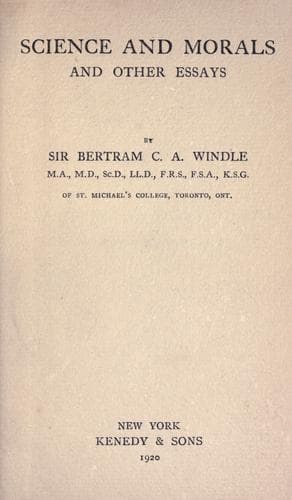
Science and Morals and Other EssaysWindle, Bertram Coghill Alan, Sir
Religion
Science and Morals and Other Essays
Windle, Bertram Coghill Alan, Sir
Essays; Religion and science; Science
Exclusive and long-continued devotion to any special line of study is
liable to lead to forgetfulness of other, even kindred, lines--almost,
in extreme cases, to a kind of atrophy of other parts of the mind. There
is the example of Darwin and his self-confessed loss of the aesthetic
tastes he once possessed. Nor are scientific studies the only ones to
produce such an effect. The amusing satire in _The New Republic_ has,
perhaps, lost some of its tang now that the prototype of its Professor
of History is almost forgotten, but it has not lost its point. Lady
Ambrose tells the tale: "He said to me in a very solemn voice, 'What a
terrible defeat that was which we had at Bouvines!' I answered
timidly--not thinking we were at war with anyone--that I had seen
nothing about it in the papers. 'H'm!' he said, giving a sort of grunt
that made me feel dreadfully ignorant, 'why, I had an excursus on it
myself in the _Archaeological Gazette_ only last week.' And, do you know,
it turned out that the Battle of Bouvines was fought in the Thirteenth
Century, and had, as far as I could make out, something to do with Magna
Charta."
It is, however, among writers on biological subjects that we find the
most salient instances of this contraction. With extraordinary
self-abnegation they seem, in the contemplation of the problem with
which they are concerned, to forget that they themselves are living
things, and, more than that, the living things of whom they ought to
know and could know most, however little that most may be. When the
biologist begins to philosophise as, after the manner of his kind, he
often does, he should leave his microscope and look around him; whereas
he often forgets even to change the high for the low power. Thus he
limits his field of vision and forgets, when attempting his explanation,
that it is only _within a system_ that he is working. Professor Ward, in
_Naturalism and Agnosticism_, says:
"From the strict premisses of Positivism we can never prove
the existence of other minds or find a place for such
conceptions as cause and substance; for into these premisses
the existence of our own mind and its self-activity have not
entered. And accordingly we have seen Naturalism led on in
perfect consistency to resolve man into an automaton that
goes of itself as part of a still vaster automaton, Nature
as mechanically conceived, which goes of itself. True, this
mechanism goes of itself because it _is_ going, and being
altogether inert, cannot stop or change. How it ever started
is indeed a question which science cannot answer, but which,
on the other hand, it has no occasion to ask: time, its one
independent variable, extends indefinitely without hint of
either beginning or end. Such a system of knowledge, _once
we are inside it_, so to say, is entirely self-contained and
complete."
Public-domain text, read in full here on John Shaqi.
Reviews
Reviews
No reviews yet
Be the first to share your thoughts on this work.
Join the Discussion
Join the discussion
Sign in to leave a comment or review.
Sign InorCreate an account