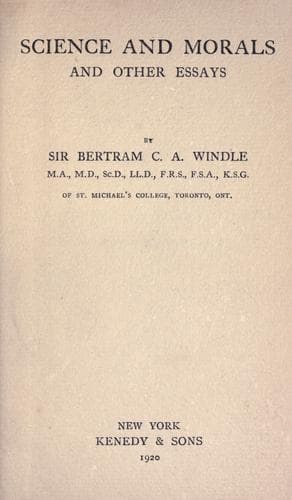
Science and Morals and Other EssaysWindle, Bertram Coghill Alan, Sir
Religion
Science and Morals and Other Essays
Windle, Bertram Coghill Alan, Sir
Essays; Religion and science; Science
"_Once we are inside it!_" what so many writers forget or ignore is that
they _are_ inside it, and that their explanations do not explain the
system or how it came to be there or to be in operation. Everybody is
familiar with Paley's example of the watch found on the heath. Let us
carry it a little further. Suppose some student, after devoting years of
patient examination to the watch, were to come forward and say: "I have
discovered the secret of this watch. There is a spring in it which
possesses resiliency, and it is that which drives the wheels. I think I
have heard people say that there must have been a watchmaker to design
and construct this piece of machinery, but, in face of my discoveries,
any such explanation is wholly unnecessary and may be altogether
abandoned."
Perhaps this analogy may be regarded as exaggerated; but, before thus
condemning it, let the following passage be studied. It is from a very
important book recently published, which claims (and has had its claim
supported by many periodicals) to have done away with any need for an
explanation of life beyond that which can be given by chemistry and
physics, Jacques Loeb's _Organism as a Whole, from a Physico-Chemical
Viewpoint_.
It would be hard to find a worse example of confused thinking than that
of the following passage:
"The idea that the organism as a whole cannot be explained
from a physico-chemical viewpoint rests most strongly on the
existence of animal instincts and will. Many of the
instinctive actions are 'purposeful,' _i.e._ assisting to
preserve the individual and the race. This again suggests
'design' and a designing 'force,' which we do not find in
the realm of physics. We must remember, however, that there
was a time when the same 'purposefulness' was believed to
exist in the cosmos where everything seemed to turn
literally and metaphorically around the earth, the abode of
man. In the latter case, the anthropo- or geo-centric view
came to an end when it was shown that the motions of the
planets were regulated by Newton's law, _and that there was
no room left for the activities of a guiding power_.
Likewise, in the realm of instincts, when it can be shown
that these instincts may be reduced to elementary
physico-chemical laws, the assumption of design becomes
superfluous." (_Italics mine._)
Public-domain text, read in full here on John Shaqi.
Reviews
Reviews
No reviews yet
Be the first to share your thoughts on this work.
Join the Discussion
Join the discussion
Sign in to leave a comment or review.
Sign InorCreate an account