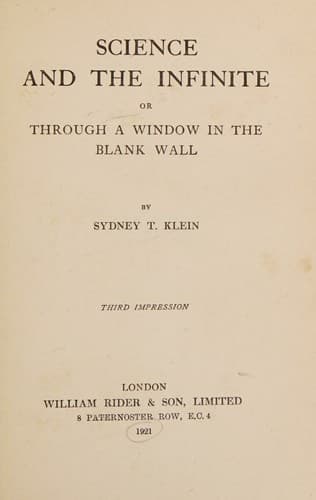
Science and the Infinite; or, Through a Window in the Blank WallKlein, Sydney T. (Sydney Turner)
Religion
Science and the Infinite; or, Through a Window in the Blank Wall
Klein, Sydney T. (Sydney Turner)
Religion and science
that a dragon-fly, whose wings vibrate about 200 times per second, had
only half the number of unit perceptions of the fly and could
apparently see motion at about one inch per second but not under. In
the converse of the above we have then the principle of a Microscope
for Time, somewhat similar to the Microscope for Space of our
laboratories. If our perception were increased sufficiently we could
slow down any motion for examination, however rapid; there would be no
difficulty in following a lightning flash or even arresting its
visible motion for purposes of investigation without interfering with
the natural sequence of cause and effect.
If, on the other hand, our perception were decreased below six times
per second, all motion would be accelerated, until with perception
reduced to one unit in twenty-four hours the sun would appear only as
a band across the sky, and we could not follow its motion any more
than, as we have seen, we could follow the point of a red-hot match.
If perception were reduced far enough, plants and trees would grow up
visibly before our eyes. But we must leave this subject now, as this
and the Time Microscope will be treated in a later View.
Let us try and appreciate the fact that, under our present conditions,
our conceptions of the immense and minute--namely, extension in Space,
and that of quick and slow or duration in Time--are purely relative,
and that from this arise those pseudo-conceptions which we call the
infinitely extended and the infinitely lasting. Under our present
limitations it is impossible for us to grasp the whole of any Truth,
if we could do that, there would be no such mystery of Infinity to
puzzle us; we could, as it were, see all around it, but that is again
looking through another window. We are now considering _relativity_.
If we cut off the very end of the point of the finest needle, we get
so minute a particle of steel that it is hardly visible to the naked
eye, and yet we know that that small speck contains not only millions
but millions of millions of what are called atoms, all in intense
motion and never touching each other. Try and conceive how small each
of these atoms must be, and then try and grasp the fact, only lately
proved by the discovery of Radio-activity, that each of these atoms is
a great family made up of bodies analogous to the planets of our solar
system and whose rate of motion is comparable only to that of Light.
This is not theory, it is fact clearly demonstrated to us by the study
of Radio-activity. Curiously enough, we know more about these bodies
than we do of the atom itself; we actually know their size and weight
and the speed with which they move. We do not yet know what is at the
centre of this system, but we do know that each of these bodies is as
far away from the centre as our planet is from the sun (93,000,000
miles), and as far from its neighbours as our planet is, _relatively
to its size_. And now, for the purpose of grasping this subject of
Public-domain text, read in full here on John Shaqi.
Reviews
Reviews
No reviews yet
Be the first to share your thoughts on this work.
Join the Discussion
Join the discussion
Sign in to leave a comment or review.
Sign InorCreate an account