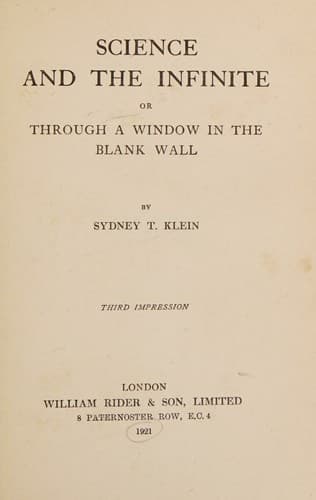
Science and the Infinite; or, Through a Window in the Blank Wall — John Shaqi
Science and the Infinite; or, Through a Window in the Blank WallKlein, Sydney T. (Sydney Turner)
Religion
Science and the Infinite; or, Through a Window in the Blank Wall
Klein, Sydney T. (Sydney Turner)
Religion and science
Even apart from our senses we find Motion giving the characteristics
of solidity: a wheel with only a few spokes, if rotated quickly
enough, becomes quite impermeable to any substance, however small,
thrown at it; a thin jet of water only half an inch in diameter, if
discharged at great pressure equivalent to a column of water of 500
metres, cannot be cut even with an axe, it resists as though it were
made of the hardest steel; a thin cord, hanging from a vertical axis,
and being revolved very quickly, becomes rigid, and if struck with a
hammer it resists and resounds like a rod of wood; a thin chain and
even a loop of string, if revolved at great speed over a vertical
pulley, becomes rigid and, if allowed to escape from the pulley, will
run along the ground as a hoop.
Now with regard to this limit of time perception, which gives us the
phenomenon of Solidity, I have lately been able to devise an
arrangement which, acting as a microscope for Time, gives the
sensation of an increase in sight perception up to several thousand
units per second; it is based on the fact that though the eye can only
see six times per second it can see for the one-millionth part of a
second. An example of this is the well-known experiment of seeing a
bullet in its flight; the bullet makes electrical connection resulting
in a spark which illuminates the bullet when opposite the eye. The
electrical spark exists only for the millionth of a second, and as the
bullet in that time has no perceptible movement it is seen standing
absolutely still with all marks upon it quite visible to the eye. When
Sight perception is increased up to the rate at which time may be said
to flow for any particular object we apparently get into the reality,
the permanent _now_ where motion ceases to exist as a sensation. A
tuning-fork, kept vibrating, by means of an electro-magnet, at 2000
times per second, may to our sense of sight be gradually slowed down
and, optically, brought absolutely to a standstill, for as long as
desired, and the smallest irregularity of its surface may be minutely
examined, though it continues to be heard and felt vibrating at that
enormous rate. I have made several experiments in this direction, and
some very curious facts connected with the sensation of Motion are
brought to light by means of this increase in perceptive power. If the
sense of sight is increased to 125 units per second, motion at the
rate of one inch per second is barely visible; taking the common
house-fly, whose wings vibrate about 400 times per second, its units
of perception would appear to be about two-thirds of those beats, as I
found it had no cognisance of Motion below two inches per second; you
can put your finger on any fly provided you do not approach it faster
than the above rate, it turns its head up to look at your finger but
can see no motion in it; if you approach at over three inches per
second it will always fly away before you are within a foot. I found
Public-domain text, read in full here on John Shaqi.
Reviews
Reviews
No reviews yet
Be the first to share your thoughts on this work.
Join the Discussion
Join the discussion
Sign in to leave a comment or review.
Sign InorCreate an account