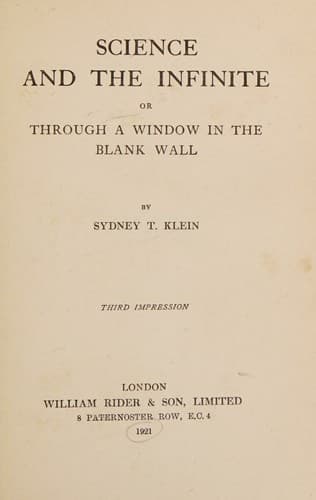
Science and the Infinite; or, Through a Window in the Blank Wall — John Shaqi
Science and the Infinite; or, Through a Window in the Blank WallKlein, Sydney T. (Sydney Turner)
Religion
Science and the Infinite; or, Through a Window in the Blank Wall
Klein, Sydney T. (Sydney Turner)
Religion and science
At the root of Socratic teaching was the idea that wisdom is the
attribute of the Godhead, and Plato, for twenty years the companion
and most favoured pupil of Socrates, was imbued with that doctrine,
and, having arrived at the conclusion that the impulse to find out
TRUTH was the necessity of intellectual man, he saw in Geometry the
keystone of all Knowledge, because, among all other channels of
thought, it alone was the exponent of absolute and undeniable truth.
He tells us that "Geometry rightly treated is the Knowledge of the
Eternal"; and Plutarch gives us yet another instance of Plato's
teaching concerning this subject, in which he looks upon God as the
Great Architect, when he says, "Plato says that God is always
geometrising." Holding, therefore, as Plato did, that God was a great
Geometer, and that the aim of philosophy was the acquisition of a
knowledge of the Eternal, it is natural that he should make a
knowledge of Geometry imperative on those wishing to study philosophy.
This was continued also by those philosophers who succeeded Plato in
the management of the Academy, as we are told that Zenocrates turned
away an applicant for admission, who knew no geometry, with the words:
[Greek: poreuou, labas gar ouk echeis tes philosophias.]
"Depart, for thou hast not the _grip_ of philosophy."
In connection with the idea that God was a Geometer, must be taken the
contention held by the Egyptians, and after them the Greeks and Arabs,
that the Right-Angled Triangle symbolised the nature of the Universe;
it was called the law of the three squares, because in every
Right-Angled Triangle, as expounded by the Pythagorean Theorem, the
squares, formed on the two sides containing the Right Angle, must
together be exactly equal to the square on the third side, whatever
the shape of the triangle may be. The Right Angle at an early date
gave its name to the odd numbers, which were called, by the Greeks,
gnomonic numbers, as personifying the male sex, and the Right-Angled
Triangle was also called the Nuptial Figure, or Marriage, the
Pythagorean Theorem receiving the name, [Greek: to theorema tes
nymphes] (the Theorem of the Bride). Plutarch, in his _Osiris and
Isis_, tells us in explanation of this, "The Egyptians imagined the
nature of the Universe like this most beautiful triangle, as Plato
also seems to have done in his work on the _State_, when he sketches
the picture of Matrimony under the form of a Right-Angled Triangle.
That triangle contains one of the perpendiculars of three, the base of
four, and the hypotenuse of five parts, the square of which is equal
to the squares of those sides containing the right angle. The
perpendicular (three) is the Male, Osiris, the originating principle
([Greek: arche]); the base (four) is the Female, Isis, the receptive
principle ([Greek: hypodoche]); and the Hypotenuse (five) is the
offspring of both, Horus, the product ([Greek: apotelesma])." The
Public-domain text, read in full here on John Shaqi.
Reviews
Reviews
No reviews yet
Be the first to share your thoughts on this work.
Join the Discussion
Join the discussion
Sign in to leave a comment or review.
Sign InorCreate an account