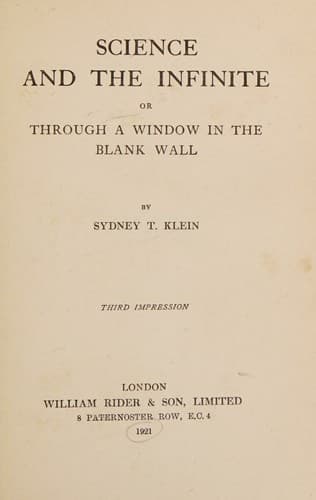
Science and the Infinite; or, Through a Window in the Blank WallKlein, Sydney T. (Sydney Turner)
Religion
Science and the Infinite; or, Through a Window in the Blank Wall
Klein, Sydney T. (Sydney Turner)
Religion and science
basis found exactly applicable to the work of the fifteenth century,
since which time mathematical proportions have been generally
employed." And after referring to numerous scale drawings of Churches,
windows, doors, and arches, he points out that every student of Church
architecture must pronounce those of the untraceried and traceried
first point to be the most beautiful of all, those of the Norman to be
a degree less so, and those of the perpendicular and debased to be far
inferior to either, and in that analysis we find that the Equilateral
Triangle was used almost exclusively for determining one order (the
Gothic), the Square for another (the Norman), and the Square
diagonally divided for the other (the debased).
Now let me try to describe the wonderful properties of the Vesica
Piscis, so that you may understand the mystery which shrouded it in
the minds of those Mediaeval builders. The rectangle formed by the
length and breadth of this figure, in the simplest form, has several
extraordinary properties; it may be cut into three equal parts by
straight lines parallel to the shorter side, and these parts will all
be precisely and geometrically similar to each other and to the whole
figure,--strangely applicable to the symbolism attached at that time
to the Trinity in Unity,--and the subdivision may be proceeded with
indefinitely without making any change in form. However often the
operation is performed, the parts remain identical with the original
figure, having all its extraordinary properties, the Equilateral
Triangle appearing everywhere, whereas no other rectangle can have
this curious property.
It may also be cut into four equal parts by straight lines parallel to
its sides, and again each of these parts will be true Vesicas, exactly
similar to each other, and to the whole, and of course the Equilateral
Triangle is again everywhere.
Again, if two out of the tri-subdivisions mentioned above be taken,
the form of these together is exactly similar, geometrically, to half
the original figure, and again the Equilateral Triangle is ubiquitous
on every base line.
Again, the diagonal of the rectangle is exactly double the length of
its shorter side, which characteristic is absolutely _unique_, and
greatly increases its usefulness for plotting out designs; and this
property of course holds good for all the rectangles formed by the
original figure and for the other species of subdivision. But perhaps
its most mysterious property (though not of any practical use) to
those who had studied Geometry, and to whom this figure was the symbol
of the Divine Trinity in Unity, so dear to them, was the fact that it
actually put into their hands the means of _trisecting_ the Right
Angle.
Public-domain text, read in full here on John Shaqi.
Reviews
Reviews
No reviews yet
Be the first to share your thoughts on this work.
Join the Discussion
Join the discussion
Sign in to leave a comment or review.
Sign InorCreate an account