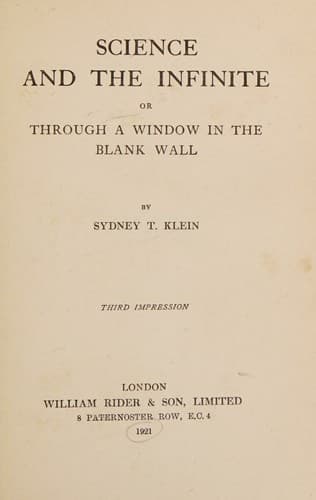
Science and the Infinite; or, Through a Window in the Blank WallKlein, Sydney T. (Sydney Turner)
Religion
Science and the Infinite; or, Through a Window in the Blank Wall
Klein, Sydney T. (Sydney Turner)
Religion and science
Now, the three great problems of antiquity which engaged the attention
and wonderment of geometricians throughout the Middle Ages, were "the
Squaring of the Circle," "the Duplication of the Cube," and lastly,
"the Trisection of an Angle," even Euclid being unable to show how to
do it; and yet it will be seen that the diagonal of one of the
subsidiary figures in the tri-subdivision, together with the diagonal
of the whole figure, actually trisect the angle at the corner of the
rectangle. It is true that it only showed them how to trisect one kind
of angle, but it was that particular angle which was so dear to them
as symbolising their craft, and which was created by the Equilateral
Triangle. All these unique properties place the figure far above that
of a square for practical work, because even when the diagonal of a
square is given, it is impossible to find the exact length of any of
its sides or _vice versa_; whereas in the Vesica rectangle the
diagonal is exactly double its shorter side, and upon any length of
line which may be taken on the tracing-board as a base for elevation,
an Equilateral Triangle will be found whose sides are of course all
equal and therefore known, as they are equal to the base, and whose
line joining apex to centre of base is a true Plumb line, forming at
its foot the perfect right angle, so important in the laying of every
stone of a building.
In the volume referred to I have given a skeleton plan upon such a
scale of subdivision that a tracing-board, of 5 feet by 8 feet, would
be divided up into over one million parts, and, as all these
subdivisions are perfect representations of the original Vesica figure
with all its properties, the design of the largest building, with the
minutest detail, could be drafted with absolute accuracy. There are
many other curious properties of this Figure, but they are difficult
to explain without diagrams. I will, however, give one more example of
its creative power. The problem of describing a Pentagon must have
puzzled architects considerably in those early times, but this was
again easily accomplished by means of the Vesica. Albrecht Duerer, the
great designer and engraver, who lived at the end of the fifteenth
century, refers to the Vesica in his works (_Dureri Institutune
Geometricarum_, lib. ii. p. 56) in a way which shows that it was as
commonly known in his time as the Circle, Square, and Triangle. His
instructions for forming a Pentagon are: "Designa circino invariato
tres piscium vesicas" (describe with unchanged compasses three vesicae
piscium). Three similar circles are described with centres at the
angles of an Equilateral Triangle, forming the three Vesicae, by means
of which the Pentagon is drawn, and from which also we get a beautiful
form of arch very common in the thirteenth century (_vide_
illustrations in _Magister Mathesios_). This is also the method used
in that old manuscript of the fifteenth century named "Geometria
deutsch." In this old MS.
Public-domain text, read in full here on John Shaqi.
Reviews
Reviews
No reviews yet
Be the first to share your thoughts on this work.
Join the Discussion
Join the discussion
Sign in to leave a comment or review.
Sign InorCreate an account