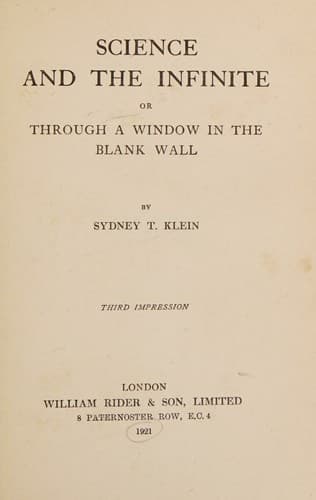
Science and the Infinite; or, Through a Window in the Blank Wall — John Shaqi
Science and the Infinite; or, Through a Window in the Blank WallKlein, Sydney T. (Sydney Turner)
Religion
Science and the Infinite; or, Through a Window in the Blank Wall
Klein, Sydney T. (Sydney Turner)
Religion and science
The power of influence, by sympathetic action, may also be seen in
another direction; consider the fact that if we are in a room with a
piano and we sing a certain note, say E flat, we not only hear that
note coming back from the piano, but, if we examine the strings, we
find that all the E flats are actually vibrating in sympathy, because
they are in perfect harmony with the note given out by the voice; but
none of the other strings are responding because they are out of
harmony. With this simile in mind, let us consider the curious fact
that a moth always lays its eggs on that particular plant upon which
the caterpillars, when they hatch out of these eggs, must feed. The
study of the Life History of Insects has always been of great interest
to me, as I firmly believe that we are on the verge of a great
discovery, and that the first indications are being revealed to us
through the investigation of the Biology of Insects. Some of you may,
perhaps, have watched this progress of ovipositing, as I have done,
and noticed how the female moth will hover in a peculiar way over
different plants, but does not alight until she comes to a plant near
akin to the one she is seeking. She then alights, but remains, on
tip-toe as it were, with legs outstretched and wings quivering, and
soon mounts again into the air; it is only when she alights on the
proper food plant that she shows unmistakably that she knows her quest
is ended and her eggs are laid. This particular plant has no other
attractions for her, she takes her food irrespectively from any other
flower which secretes honey, and yet, when she is ready to fulfil her
destiny, she is unerringly drawn towards that particular plant which
must be the food of her offspring. What is this wonderful sense? We
call it instinct, a name which is made to cover all other senses in
the lower animals, of which we have no cognisance ourselves. Let us
take our own senses as a guide: we find that they are all based on the
appreciation of frequencies, of greater or less rapidity, by means of
organs specially adapted to vibrate in sympathy with those pulsations,
and thus we gain knowledge of external things. Two tuning forks or two
organ pipes when vibrating close to each other, give out a pure
musical note when they are in perfect harmony, and they then have, as
it were, "rest" together; but when one is put even slightly out of
harmony, there is, in place of a pure musical note, a rise and fall of
sound in heavy throbs, strangely characteristic of "quarrelling"; in
fact, discord and "unrest."
Public-domain text, read in full here on John Shaqi.
Reviews
Reviews
No reviews yet
Be the first to share your thoughts on this work.
Join the Discussion
Join the discussion
Sign in to leave a comment or review.
Sign InorCreate an account