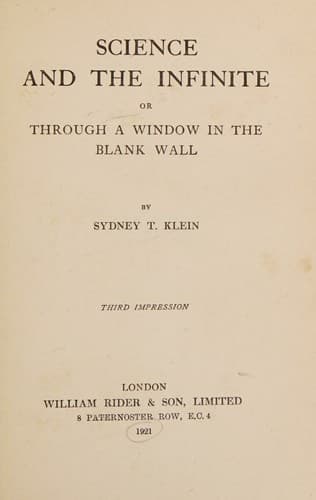
Science and the Infinite; or, Through a Window in the Blank Wall — John Shaqi
Science and the Infinite; or, Through a Window in the Blank WallKlein, Sydney T. (Sydney Turner)
Religion
Science and the Infinite; or, Through a Window in the Blank Wall
Klein, Sydney T. (Sydney Turner)
Religion and science
In our sense of hearing we can only appreciate up to 40,000 vibrations
in a second as a musical sound, whereas, with Light and other
electrical phenomena, as we shall see in a later View, we can
appreciate sympathetic frequencies of not only many millions, but
indeed millions of millions in a second, and yet it is possible that,
in the sense (of insects) we are now examining of life appreciating
life, we may be in the presence of frequencies as far removed from
light as light is from sound. If, then, we may follow the analogy from
our highest senses, we seem to get a clear explanation of the mystery
of insect discrimination. The insect, in her then state, could have no
pleasure in the presence of certain plants, their modes of frequency
being out of sympathy with that particular Insect Life, and, it may be
conceived that, not only is there no inducement for the insect to
alight on that plant, but that even in its near proximity that insect
would feel discomfort or restlessness; when, however, a plant is
reached which is near akin to the one required, less antipathy or
unrest would be felt, and, when the true species of plant is reached,
all would be harmony, pleasure, and rest, the functions of Insect Life
would be vivified, and its life-work accomplished under the influences
of sympathetic action.
I have made several other investigations on this subject, but I must
only give one more to illustrate the higher form of Animal Life
appreciating Animal Life. There is a large class of insects, called
Ichneumonidae, which lay their eggs in the bodies of caterpillars, and,
as in the case of a moth laying its egg on the special food plant upon
which its caterpillar can feed, so does each species of these insects
unerringly lay its eggs in the body of a particular kind of
caterpillar. It must be a wonderful sense which can enable an
Ichneumon Fly to do this; it has never seen that caterpillar before,
as the egg, from which its own caterpillar was hatched, was laid
inside the body of one of those caterpillars, and the caterpillar upon
which it fed had been eaten up and disappeared at least six months
before the Ichneumon Fly had even made its way out of its own cocoon;
and yet this insect is not only forced, by some mysterious power, to
lay its egg in the body of a caterpillar, but there is only one
species which will serve its purpose, and it has to hunt up this
particular caterpillar from among thousands of other different
species.
Public-domain text, read in full here on John Shaqi.
Reviews
Reviews
No reviews yet
Be the first to share your thoughts on this work.
Join the Discussion
Join the discussion
Sign in to leave a comment or review.
Sign InorCreate an account