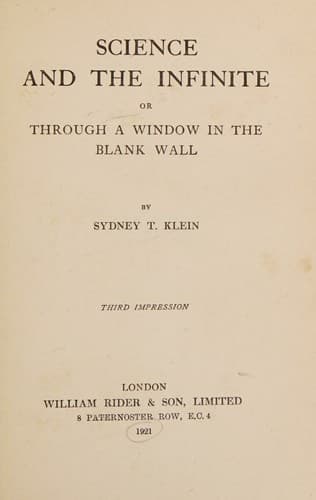
Science and the Infinite; or, Through a Window in the Blank Wall — John Shaqi
Science and the Infinite; or, Through a Window in the Blank WallKlein, Sydney T. (Sydney Turner)
Religion
Science and the Infinite; or, Through a Window in the Blank Wall
Klein, Sydney T. (Sydney Turner)
Religion and science
It is easy to see that the negatives, Cold, Ignorance, Falsehood,
Ugliness are manifestations of their positives, as given in my list
in View One, and it is also not difficult to show that Evil or Sin is
dependent upon Good in the same way as the Shadow depends upon Light
for its manifestation. Do not let me be misunderstood; I have never
suggested that these negatives or negations have not the appearance of
realities to us, under our present conditions of existence; they
indeed have to be dealt with by us as realities, but they are only
manifested as phenomena on the physical plane, because our Senses, and
therefore Thoughts, are limited by Time and Space and therefore
dependent upon _relativity_.
Let me put the case of Good and Evil before you, as analogous to, say,
Light and Shadow. Moral laws and responsibility thereto are dependent
upon the existence of Goodness; the purely animal Homo was, as I have
pointed out, free from sin or responsibility until the advent of the
Spiritual made manifest, in that animal, the physical Ego and raised
him far above all other animals. Man thus became a responsible moral
being, a living soul, aware of Right, and therefore of Wrong, and
certain acts then became for him sin that were not sin before. Thus
the advent of Christ, and, in a less degree, the coming into the world
of every good man, so raised, and is raising, the level of moral
rectitude that things become sin that were not sin before; St. Paul
himself specially recognises this when he says that without law there
is no sin. The Goodness, then, brought into the world by Christ, did
not create sin but made it manifest, and gave it the appearance of
reality under our present conditions of life and thought. How well the
Mystic Paul understood that the Invisible is the Real, and that the
Visible--namely, the phenomena of nature--is only dependent upon Time
for its manifestation. His words are: "For the things which are seen
are temporal, but the things which are not seen are Eternal."
Public-domain text, read in full here on John Shaqi.
Reviews
Reviews
No reviews yet
Be the first to share your thoughts on this work.
Join the Discussion
Join the discussion
Sign in to leave a comment or review.
Sign InorCreate an account