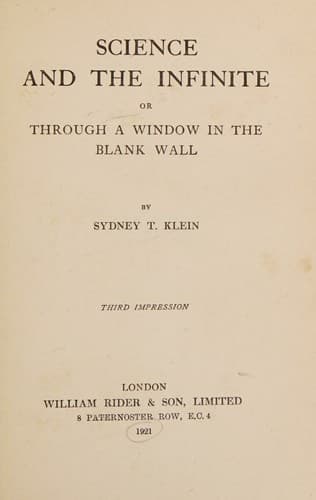
Science and the Infinite; or, Through a Window in the Blank WallKlein, Sydney T. (Sydney Turner)
Religion
Science and the Infinite; or, Through a Window in the Blank Wall
Klein, Sydney T. (Sydney Turner)
Religion and science
I have referred above to the sense of touch; it is, I think, clear
that the first impression a child can have of sight must take the form
of feeling the image on its retina, as though the object were actually
inside the head, and it could have no idea that it was outside until,
by touching with the hand, it would gradually learn by experience that
the tangible outside object corresponded with the image located in the
head; this is fully borne out by the testimony of men who, born blind,
have, by an operation, received their sight late in life; in each case
their first experience of seeing gave the impression that the object
was touching the eye, and they were quite unable to recognise by sight
an object such as a cup or plate or a round ball which they had
commonly handled and knew perfectly well by touch; in fact, the idea
of an object formed by the sense of touch is so absolutely different
to that formed by the sense of sight that it would be impossible
without past experience to conclude that the two sensations referred
to one and the same object. The image formed on the retina has nothing
in common with the sense of hardness, coldness, and weight experienced
by touch, the only impression on the retina being that of colour or
shade, and an outline; it is, however, hardly conceivable that even
the outline of form would be recognised by the eye until touch had
proved that form comprised also solidity and that the two ideas had
certain motions in common both in duration in Time and extension in
Space.
Again, our senses of sight and hearing are alike based on the
appreciation of frequencies of different rapidity; brightness and
colour in light are equivalent to loudness and pitch in sound, but in
sound we have no equivalent to perception of form or situation in
space; it gives us no knowledge of the existence of objects when
situated at great distances, nor can movements be followed even at
short distances without having material contact, by means of the air,
with the object; sight indeed appears to have to do with Space- and
sound with Time-perception. In examining Nature by means of our
senses we find we are so hemmed in by what we have always taken for
granted and so bound down by modes of reasoning derived from what we
have seen, heard, or felt in our daily life, that we are sadly
hampered in our search after the truth. It is difficult to sweep the
erroneous concepts aside and make a fresh start. In fact the great
difficulty in studying the Reality underlying Nature is analogous to
our inability to isolate and study the different sounds themselves
which fall upon the ear, if our own language is being uttered, without
being forced to consider the meaning we have always attached to those
sounds.
Public-domain text, read in full here on John Shaqi.
Reviews
Reviews
No reviews yet
Be the first to share your thoughts on this work.
Join the Discussion
Join the discussion
Sign in to leave a comment or review.
Sign InorCreate an account