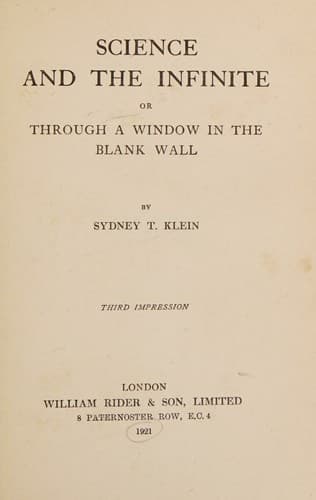
Science and the Infinite; or, Through a Window in the Blank WallKlein, Sydney T. (Sydney Turner)
Religion
Science and the Infinite; or, Through a Window in the Blank Wall
Klein, Sydney T. (Sydney Turner)
Religion and science
Let us now go back to the contention that it is not we who are looking
out upon Nature but that our senses are being bombarded from without;
we are living in a world of continuous and multitudinous changes, and
as our senses require change or motion for their excitation, without
those changes we could have no cognisance of our surroundings, we
should have no consciousness of living; but if we base our thought
entirely on sense perception, taking for granted that Time and Space
have reality instead of recognising that they are only modes or limits
under which those senses act, the Wall will ever remain opaque to us.
Let us try and make this clearer. If we analyse the impression we
receive from Motion, we find it is made up of the product of our two
limitations, it is the time that an object takes to go over a certain
space. We must come therefore to the conclusion also that Motion
itself has no existence in reality apart from our senses. The result
of not being able to appreciate this, is that the finiteness of our
sense, caused by its dependence on Motion for excitation, surrounds us
with illusions; one of these illusions is what we call solidity or
continuity of sensation. If you hold a cannon-ball in your hand,
perception by the sense of touch tells you that it is continuous, or
what is called solid and hard; but it is not so in reality except as a
concept limited by our finite senses. A fair analogy would be to liken
it to a swarm of bees, for we know that it is composed of an immense
number of independent atoms or molecules which are darting about, and
circling round each other at an enormous speed but never touching;
they are also pulsating at a definite enormous rate; we can at will
increase their motion by heat or reduce by cold; if our touch
perception were sensitive enough we should feel those motions and
should not have the sensation of a solid. We have a similar case of
limitation in our other senses, which we shall grasp better in another
View through our Window. We can hear beats only up to fifteen in a
second, beyond that number they give the sensation of a musical or
continuous sound. In our sense of sight we can see pulsations or
intermittent flashes up to only six in a second, beyond that number
they give the sensation of a continuous light; a gas jet, if
extinguished and relit six times in a second, can be seen to flicker,
but beyond that rate is to our sense of sight a steady flame. The
effect may also be shown by making the top of a match red-hot; when
stationary or moving slowly, it is a point of light, but, moved
quickly, it becomes a continuous line of light.
Public-domain text, read in full here on John Shaqi.
Reviews
Reviews
No reviews yet
Be the first to share your thoughts on this work.
Join the Discussion
Join the discussion
Sign in to leave a comment or review.
Sign InorCreate an account