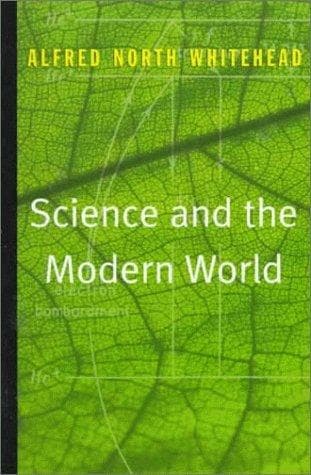
Science and the modern worldWhitehead, Alfred North
Religion
Science and the modern world
Whitehead, Alfred North
Science
A complete organism in the organic theory is what corresponds to a bit
of material on the materialistic theory. There will be a primary genus,
comprising a number of species of organisms, such that each primary
organism, belonging to a species of the primary genus, is not
decomposable into subordinate organisms. I will call any organism of the
primary genus a primate. There may be different species of primates.
It must be kept in mind that we are dealing with the abstractions of
physics. Accordingly, we are not thinking of what a primate is in
itself, as a pattern arising from the prehension of the concrete
aspects; nor are we thinking of what a primate is for its environment,
in respect to its concrete aspects prehended therein. We are thinking of
these various aspects merely in so far as their effects on patterns and
on locomotion are expressible in spatio-temporal terms. Accordingly, in
the language of physics, the aspects of a primate are merely its
contributions to the electromagnetic field. This is in fact exactly what
we know of electrons and protons. An electron for us is merely the
pattern of its aspects in its environment, so far as those aspects are
relevant to the electromagnetic field.
Now in discussing the theory of relativity, we saw that the relative
motion of two primates means simply that their organic patterns are
utilising diverse space-time systems. If two primates do not continue
either mutually at rest, or mutually in uniform relative motion, at
least one of them is changing its intrinsic space-time system. The laws
of motion express the conditions under which these changes of space-time
systems are effected. The conditions for vibratory _locomotion_ are
founded upon these general laws of motion.
But it is possible that certain species of primates are apt to go to
pieces under conditions which lead them to effect changes of space-time
systems. Such species would only experience a long range of endurance,
if they had succeeded in forming a favourable association among primates
of different species, such that in this association the tendency to
collapse is neutralised by the environment of the association. We can
imagine the atomic nucleus as composed of a large number of primates of
differing species, and perhaps with many primates of the same species,
the whole association being such as to favour stability. An example of
such an association is afforded by the association of a positive nucleus
with negative electrons to obtain a neutral atom. The neutral atom is
thereby shielded from any electric field which would otherwise produce
changes in the space-time system of the atom.
Public-domain text, read in full here on John Shaqi.
Reviews
Reviews
No reviews yet
Be the first to share your thoughts on this work.
Elsewhere in the archive
Join the Discussion
Join the discussion
Sign in to leave a comment or review.
Sign InorCreate an account