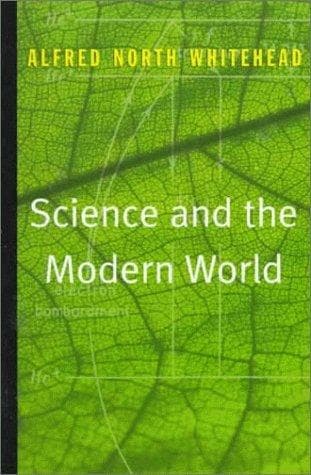
Science and the modern worldWhitehead, Alfred North
Religion
Science and the modern world
Whitehead, Alfred North
Science
There is, however, a limitation to be made to the generality of
mathematics; it is a qualification which applies equally to all general
statements. No statement, except one, can be made respecting any remote
occasion which enters into no relationship with the immediate occasion
so as to form a constitutive element of the essence of that immediate
occasion. By the ‘immediate occasion’ I mean that occasion which
involves as an ingredient the individual act of judgment in question.
The one excepted statement is,—If anything out of relationship, then
complete ignorance as to it. Here by ‘ignorance,’ I mean _ignorance_;
accordingly no advice can be given as to how to expect it, or to treat
it, in ‘practice’ or in any other way. Either we know something of the
remote occasion by the cognition which is itself an element of the
immediate occasion, or we know nothing. Accordingly the full universe,
disclosed for every variety of experience, is a universe in which every
detail enters into its proper relationship with the immediate occasion.
The generality of mathematics is the most complete generality consistent
with the community of occasions which constitutes our metaphysical
situation.
It is further to be noticed that the particular entities require these
general conditions for their ingression into any occasions; but the same
general conditions may be required by many types of particular entities.
This fact, that the general conditions transcend any one set of
particular entities, is the ground for the entry into mathematics, and
into mathematical logic, of the notion of the ‘variable.’ It is by the
employment of this notion that general conditions are investigated
without any specification of particular entities. This irrelevance of
the particular entities has not been generally understood: for example,
the shape-iness of shapes, _e.g._, circularity and sphericity and
cubicality as in actual experience, do not enter into the geometrical
reasoning.
The exercise of logical reason is always concerned with these absolutely
general conditions. In its broadest sense, the discovery of mathematics
is the discovery that the totality of these general abstract conditions,
which are concurrently applicable to the relationships among the
entities of any one concrete occasion, are themselves inter-connected in
the manner of a pattern with a key to it. This pattern of relationships
among general abstract conditions is imposed alike on external reality,
and on our abstract representations of it, by the general necessity that
every thing must be just its own individual self, with its own
individual way of differing from everything else. This is nothing else
than the necessity of abstract logic, which is the presupposition
involved in the very fact of interrelated existence as disclosed in each
immediate occasion of experience.
Public-domain text, read in full here on John Shaqi.
Reviews
Reviews
No reviews yet
Be the first to share your thoughts on this work.
Join the Discussion
Join the discussion
Sign in to leave a comment or review.
Sign InorCreate an account