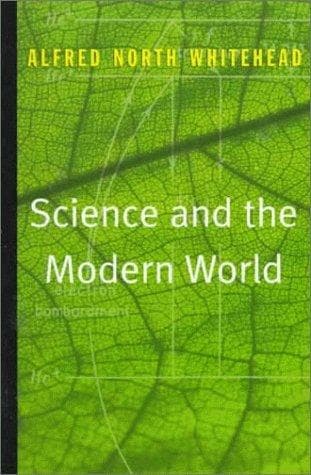
Science and the modern worldWhitehead, Alfred North
Religion
Science and the modern world
Whitehead, Alfred North
Science
The history of the development of language illustrates this point. It is
a history of the progressive analysis of ideas. Latin and Greek were
inflected languages. This means that they express an unanalyzed complex
of ideas by the mere modification of a word; whereas in English, for
example, we use prepositions and auxiliary verbs to drag into the open
the whole bundle of ideas involved. For certain forms of literary
art,—though not always—the compact absorption of auxiliary ideas into
the main word may be an advantage. But in a language such as English
there is the overwhelming gain in explicitness. This increased
explicitness is a more complete exhibition of the various abstractions
involved in the complex idea which is the meaning of the sentence.
By comparison with language, we can now see what is the function in
thought which is performed by pure mathematics. It is a resolute attempt
to go the whole way in the direction of complete analysis, so as to
separate the elements of mere matter of fact from the purely abstract
conditions which they exemplify.
The habit of such analysis enlightens every act of the functioning of
the human mind. It first (by isolating it) emphasizes the direct
aesthetic appreciation of the content of experience. This direct
appreciation means an apprehension of what this experience is in itself
in its own particular essence, including its immediate concrete values.
This is a question of direct experience, dependent upon sensitive
subtlety. There is then the abstraction of the particular entities
involved, viewed in themselves, and as apart from that particular
occasion of experience in which we are then apprehending them. Lastly
there is the further apprehension of the absolutely general conditions
satisfied by the particular relations of those entities as in that
experience. These conditions gain their generality from the fact that
they are expressible without reference to those particular relations or
to those particular relata which occur in that particular occasion of
experience. They are conditions which might hold for an indefinite
variety of other occasions, involving other entities and other relations
between them. Thus these conditions are perfectly general because they
refer to no particular occasion, and to no particular entities (such as
green, or blue, or trees) which enter into a variety of occasions, and
to no particular relationships between such entities.
Public-domain text, read in full here on John Shaqi.
Reviews
Reviews
No reviews yet
Be the first to share your thoughts on this work.
Join the Discussion
Join the discussion
Sign in to leave a comment or review.
Sign InorCreate an account