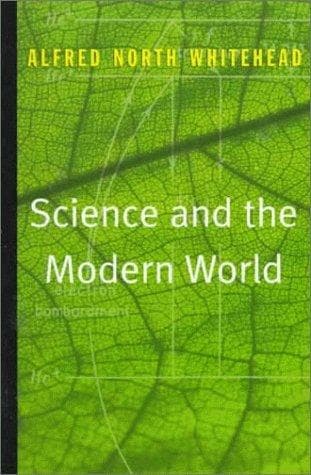
Science and the modern worldWhitehead, Alfred North
Religion
Science and the modern world
Whitehead, Alfred North
Science
In the second place, a new problem is now placed before philosophers and
physicists, if we entertain the hypothesis that the ultimate elements of
matter are in their essence vibratory. By this I mean that apart from
being a periodic system, such an element would have no existence. With
this hypothesis we have to ask, what are the ingredients which form the
vibratory organism. We have already got rid of the matter with its
appearance of undifferentiated endurance. Apart from some metaphysical
compulsion, there is no reason to provide another more subtle stuff to
take the place of the matter which has just been explained away. The
field is now open for the introduction of some new doctrine of organism
which may take the place of the materialism with which, since the
seventeenth century, science has saddled philosophy. It must be
remembered that the physicists’ energy is obviously an abstraction. The
concrete fact, which is the organism, must be a complete expression of
the character of a real occurrence. Such a displacement of scientific
materialism, if it ever takes place, cannot fail to have important
consequences in every field of thought.
Finally, our last reflection must be, that we have in the end come back
to a version of the doctrine of old Pythagoras, from whom mathematics,
and mathematical physics, took their rise. He discovered the importance
of dealing with abstractions; and in particular directed attention to
number as characterizing the periodicities of notes of music. The
importance of the abstract idea of periodicity was thus present at the
very beginning both of mathematics and of European philosophy.
In the seventeenth century, the birth of modern science required a new
mathematics, more fully equipped for the purpose of analysing the
characteristics of vibratory existence. And now in the twentieth century
we find physicists largely engaged in analysing the periodicities of
atoms. Truly, Pythagoras in founding European philosophy and European
mathematics, endowed them with the luckiest of lucky guesses—or, was it
a flash of divine genius, penetrating to the inmost nature of things?
CHAPTER III
THE CENTURY OF GENIUS
Public-domain text, read in full here on John Shaqi.
Reviews
Reviews
No reviews yet
Be the first to share your thoughts on this work.
Join the Discussion
Join the discussion
Sign in to leave a comment or review.
Sign InorCreate an account