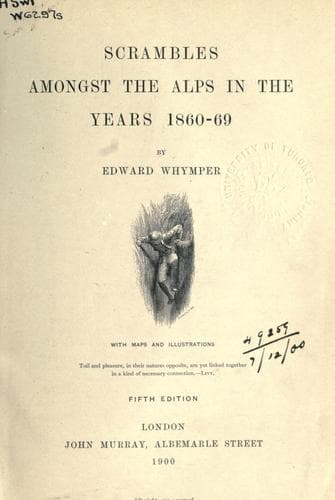
Scrambles Amongst the Alps in the Years 1860-69 — John Shaqi
Scrambles Amongst the Alps in the Years 1860-69Whymper, Edward
History
Scrambles Amongst the Alps in the Years 1860-69
Whymper, Edward
Alps -- Description and travel; Mountaineering -- Alps -- History -- 19th century; Mountaineers -- Biography; Whymper, Edward, 1840-1911
At five on a lovely morning I shouldered my knapsack and started for
Briançon. Gauzy mists clung to the mountains, but melted away when
touched by the sun, and disappeared by jerks (in the manner of views
when focused in a magic lantern), revealing the wonderfully bent and
folded strata in the limestone cliffs behind the town. Then I entered
the Combe de Malval, and heard the Romanche eating its way through that
wonderful gorge, and passed on to Le Dauphin, where the first glacier
came into view, tailing over the mountain-side on the right. From this
place until the summit of the Col de Lautaret was passed, every gap in
the mountains showed a glittering glacier or a soaring peak: the finest
view was at La Grave, where the Meije rises by a series of tremendous
precipices eight thousand feet above the road. The finest distant view
of the pass is seen after crossing the col, near Monetier. A mountain,
commonly supposed to be Monte Viso, appears at the end of the vista,
shooting into the sky: in the middle distance, but still ten miles off,
is Briançon with its interminable forts, and in the foreground, leading
down to the Guisane and rising high up the neighboring slopes, are
fertile fields, studded with villages and church-spires. The next day I
walked over from Briançon to La Bessée, to my worthy friend Jean
Reynaud, the surveyor of roads of his district.
[Illustration: MONT PELVOUX FROM ABOVE BESSÉE]
All the peaks of Mont Pelvoux are well seen from La Bessée—the highest
point as well as that upon which the French engineers erected their
cairn in 1828. Neither Reynaud nor any one else knew this. The natives
knew only that the engineers had ascended one peak, and had seen from
that a still higher point, which they called the Pointe des Arcines or
des Écrins. They could not say whether this latter could be seen from
La Bessée, nor could they tell the peak upon which the cairn had been
erected. We were under the impression that the highest point was
concealed by the peaks we saw, and would be gained by passing over
them. They knew nothing of the ascent of Monsieur Puiseux, and they
confidently asserted that the highest point of Mont Pelvoux had not
been attained by any one: it was this point we wished to reach.
Public-domain text, read in full here on John Shaqi.
Reviews
Reviews
No reviews yet
Be the first to share your thoughts on this work.
Join the Discussion
Join the discussion
Sign in to leave a comment or review.
Sign InorCreate an account