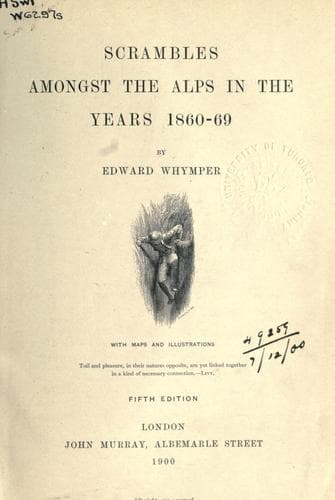
Scrambles Amongst the Alps in the Years 1860-69Whymper, Edward
History
Scrambles Amongst the Alps in the Years 1860-69
Whymper, Edward
Alps -- Description and travel; Mountaineering -- Alps -- History -- 19th century; Mountaineers -- Biography; Whymper, Edward, 1840-1911
This night we fixed our camp high above the tree-line, and indulged
ourselves in the healthy employment of carrying our fuel up to it. The
present rock was not so comfortable as the first, and before we could
settle down we were obliged to turn out a large mass which was in the
way. It was very obstinate, but moved at length—slowly and gently at
first, then faster and faster, at last taking great jumps in the air,
striking a stream of fire at every touch, which shone out brightly as
it entered the gloomy valley below; and long after it was out of sight
we heard it bounding downward, and then settle with a subdued crash on
the glacier beneath. As we turned back from this curious sight, Reynaud
asked if we had ever seen a torrent on fire, and told us that in the
spring the Durance, swollen by the melting of the snow, sometimes
brings down so many rocks that where it passes through a narrow gorge
at La Bessée no water whatever is seen, but only boulders rolling over
and over, grinding each other into powder, and striking so many sparks
that the stream looks as if it were on fire.
We had another merry evening, with nothing to mar it: the weather was
perfect, and we lay backward in luxurious repose, looking at the sky
spangled with its ten thousand brilliant lights.
The ranges stood
Transfigured in the silver flood.
Their snows were flashing cold and keen,
Dead white, save where some sharp ravine
Took shadow, or the sombre green
Of hemlocks turned to pitchy black,
Against the whiteness at their back.[1]
[1] J.G. Whittier, “Snow-Bound.”
[Illustration: R. J. S. MACDONALD]
Macdonald related his experiences over the café noir. He had traveled
day and night for several days in order to join us, but had failed to
find our first bivouac, and had encamped a few hundred yards from us
under another rock, higher up the mountain. The next morning he
discerned us going along a ridge at a great height above him, and as it
was useless to endeavor to overtake us, he lay down and watched with a
heavy heart until we had turned the corner of a buttress and vanished
out of sight.
Nothing but the heavy breathing of our already sound—asleep comrades
broke the solemn stillness of the night. It was a silence to be felt.
Nothing! Hark! what is that dull booming sound above us? Is that
nothing? There it is again, plainer: on it comes, nearer, clearer: ’tis
a crag escaped from the heights above. What a fearful crash! We jump to
our feet. Down it comes with awful fury: what power can withstand its
violence? Dancing leaping, flying, dashing against others, roaring as
it descends. Ah, it has passed! No: there it is again, and we hold our
breath as, with resistless force and explosions like artillery, it
darts past, with an avalanche of shattered fragments trailing in its
rear. ’Tis gone, and we breathe more freely as we hear the finale on
the glacier below.
Public-domain text, read in full here on John Shaqi.
Reviews
Reviews
No reviews yet
Be the first to share your thoughts on this work.
Join the Discussion
Join the discussion
Sign in to leave a comment or review.
Sign InorCreate an account