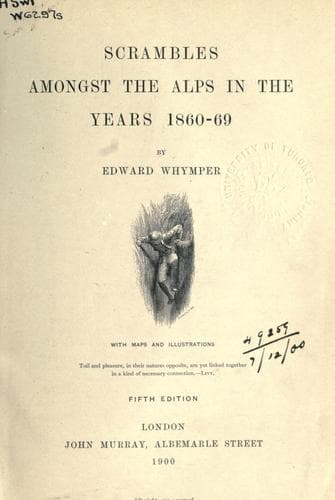
Scrambles Amongst the Alps in the Years 1860-69Whymper, Edward
History
Scrambles Amongst the Alps in the Years 1860-69
Whymper, Edward
Alps -- Description and travel; Mountaineering -- Alps -- History -- 19th century; Mountaineers -- Biography; Whymper, Edward, 1840-1911
The steam is shut off and the brakes are applied a very few minutes
after beginning the descent to Susa. The train might then run down for
the entire distance by its own weight. In practice, it is difficult to
apply the proper amount of retardation: the brakes have frequently to
be whistled off, and sometimes it is necessary to steam down against
them. Theoretically, this ought not of course to occur: it only happens
occasionally, and ordinarily the train goes down with the steam shut
off, and with the centre-rail brakes screwed up moderately. When an
average train—that is, two or three carriages and a luggage-van—is
running down at the maximum speed allowed (fifteen miles an hour), the
brakes can pull it up dead within seventy yards. The pace is properly
kept down to a low point in descending, and doing so, combined with the
knowledge that the brake-power can easily lessen it, will tend to make
the public look favorably on what might otherwise be considered a
dangerous innovation. The engines also are provided with the
centre-rail brake, on a pattern somewhat different from those on the
carriages, and the flat sides which press against the rails are renewed
_every journey._ It is highly desirable that they should be, for a
single run from Lanslebourg to Susa grinds a groove into them about
three-eighths of an inch in depth.
[Illustration: CENTRE RAIL BRAKE]
Driving the trains over the summit section requires the most constant
attention and no small amount of nerve, and the drivers, who are all
English, have well earned their money at the end of their run. Their
opinion of the line was concisely and forcibly expressed to me by one
of them in last August: “Yes, mister, they told us as how the line was
very steep, but they didn’t say that the engine would be on one curve,
when the fourgon was on another, and the carriages was on a third. Them
gradients, too, mister, they says they are one in twelve, but I think
they are one in _ten, at the least_, and they didn’t say as how we was
to come down them in that snakewise fashion. It’s worse than the G. I.
P.[4], mister: there a fellow could jump off, but here, in them covered
ways, there ain’t no place to jump to.”
[4] The Great Indian Peninsula Railway, the line with the celebrated
Bhore Ghaut incline, sixteen miles long, on an average gradient of one
in forty-eight, which is said to have cost £800,000, or about double
the entire cost of the Mount Cenis Railway, and six times its cost
mile for mile. The Fell Railway cost £8000 per mile.
[Illustration: THE MATTERHORN FROM NEAR THE SUMMIT OF THE THEODULE
PASS.]
CHAPTER IV.
MY FIRST SCRAMBLE ON THE MATTERHORN.
Public-domain text, read in full here on John Shaqi.
Reviews
Reviews
No reviews yet
Be the first to share your thoughts on this work.
Join the Discussion
Join the discussion
Sign in to leave a comment or review.
Sign InorCreate an account