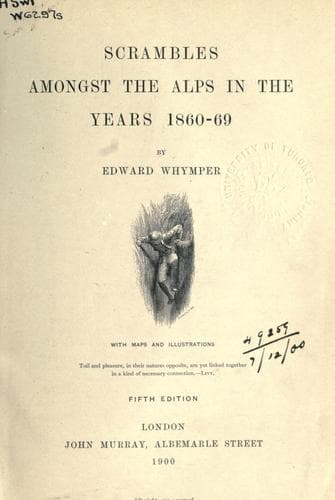
Scrambles Amongst the Alps in the Years 1860-69Whymper, Edward
History
Scrambles Amongst the Alps in the Years 1860-69
Whymper, Edward
Alps -- Description and travel; Mountaineering -- Alps -- History -- 19th century; Mountaineers -- Biography; Whymper, Edward, 1840-1911
When walking up toward Breuil, we inquired for another man of all the
knowing ones, and they, with one voice, proclaimed that Jean-Antoine
Carrel, of the village of Val Tournanche, was the cock of his valley.
We sought, of course, for Carrel, and found him a well-made,
resolute-looking fellow, with a certain defiant air which was rather
taking. Yes, he would go. Twenty francs a day, whatever was the result,
was his price. I assented. But I must take his comrade. “Why so?” Oh,
it was absolutely impossible to get along without another man. As he
said this an evil countenance came forth out of the darkness and
proclaimed itself the comrade. I demurred, the negotiations broke off,
and we went up to Breuil. This place will be frequently mentioned in
subsequent chapters, and was in full view of the extraordinary peak the
ascent of which we were about to attempt.
It is unnecessary to enter into a minute description of the Matterhorn
after all that has been written about that famous mountain. My readers
will know that that peak is nearly fifteen thousand feet high, and that
it rises abruptly, by a series of cliffs which may properly be termed
precipices, a clear five thousand feet above the glaciers which
surround its base. They will know, too, that it was the last great
Alpine peak which remained unsealed—less on account of the difficulty
of doing so than from the terror inspired by its invincible appearance.
There seemed to be a _cordon_ drawn around it, up to which one might
go, but no farther. Within that invisible line jins and affreets were
supposed to exist—the Wandering Jew and the spirits of the damned. The
superstitious natives in the surrounding valleys (many of whom still
firmly believe it to be not only the highest mountain in the Alps, but
in the world) spoke of a ruined city on its summit wherein the spirits
dwelt; and if you laughed they gravely shook their heads, told you to
look yourself to see the castles and the walls, and warned one against
a rash approach, lest the infuriate demons from their impregnable
heights might hurl down vengeance for one’s derision. Such were the
traditions of the natives. Stronger minds felt the influence of the
wonderful form, and men who ordinarily spoke or wrote like rational
beings, when they came under its power seemed to quit their senses and
ranted and rhapsodized, losing for a time all common forms of speech.
Even the sober De Saussure was moved to enthusiasm when he saw the
mountain, and, inspired by the spectacle, he anticipated the
speculations of modern geologists in the striking sentences which are
placed at the head of this chapter.
The Matterhorn looks equally imposing from whatever side it is seen: it
never seems commonplace, and in this respect, and in regard to the
impression it makes upon spectators, it stands almost alone amongst
mountains. It has no rivals in the Alps, and but few in the world.
Public-domain text, read in full here on John Shaqi.
Reviews
Reviews
No reviews yet
Be the first to share your thoughts on this work.
Join the Discussion
Join the discussion
Sign in to leave a comment or review.
Sign InorCreate an account