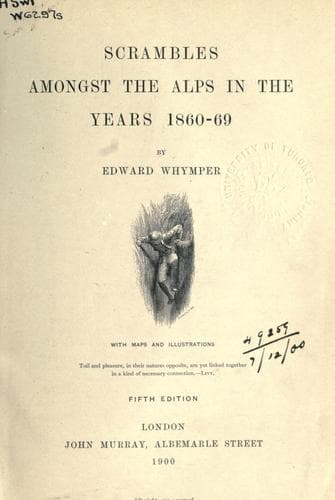
Scrambles Amongst the Alps in the Years 1860-69Whymper, Edward
History
Scrambles Amongst the Alps in the Years 1860-69
Whymper, Edward
Alps -- Description and travel; Mountaineering -- Alps -- History -- 19th century; Mountaineers -- Biography; Whymper, Edward, 1840-1911
I passed on to Switzerland; saw the sunlight lingering on the giants of
the Oberland; heard the echoes from the cow horns in the Lauterbrunnen
valley and the avalanches rattling off the Jungfrau; and then crossed
the Gemmi into the Valais, resting for a time by the beautiful
Oeschinen See, and getting a forcible illustration of glacier-motion in
a neighboring valley—the Gasteren Thal. The upper end of this valley is
crowned by the Tschingel glacier, which, as it descends, passes over an
abrupt cliff that is in the centre of its course. On each side the
continuity of the glacier is maintained, but in the centre it is cleft
in twain by the cliff. Lower down it is consolidated again. I scrambled
on to this lower portion, advanced toward the cliff, and then stopped
to admire the contrast of the brilliant pinnacles of ice with the blue
sky. Without a warning, a huge slice of the glacier broke away and fell
over the cliff on to the lower portion with a thundering crash.
Fragments rolled beyond me, although, fortunately, not in my direction.
I fled, and did not stop until off the glacier, but before it was
quitted learned another lesson in glacial matters: the terminal
moraine, which seemed to be a solid mound, broke away underneath me,
and showed that it was only a superficial covering resting on a slope
of glassy ice.
[Illustration]
On the steep path over the Gemmi there were opportunities for observing
the manners and customs of the Swiss mule. It is not perhaps in revenge
for generations of ill-treatment that the mule grinds one’s legs
against fences and stone walls, and pretends to stumble in awkward
places, particularly when coming round corners and on the brinks of
precipices; but their evil habit of walking on the outside edges of
paths (even in the most unguarded positions) is one that is distinctly
the result of association with man. The transport of wood from the
mountains into the valleys occupies most of the mules during a
considerable portion of the year: the fagots into which the wood is
made up project some distance on each side, and it is said that they
walk intuitively to the outside of paths having rocks on the other side
to avoid the collisions which would otherwise occur. When they carry
tourists they behave in a similar manner; and no doubt when the good
time for mules arrives, and they no longer carry burdens, they will
still continue, by natural selection, to do the same. This habit
frequently gives rise to scenes: two mules meet—each wishes to pass on
the outside, and neither will give way. It requires considerable
persuasion, through the medium of the tail, before such difficulties
are arranged.
Public-domain text, read in full here on John Shaqi.
Reviews
Reviews
No reviews yet
Be the first to share your thoughts on this work.
Join the Discussion
Join the discussion
Sign in to leave a comment or review.
Sign InorCreate an account