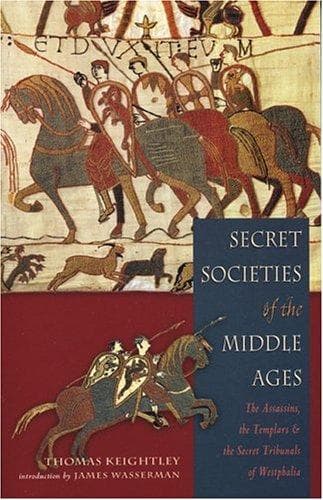
Secret Societies of the Middle AgesKeightley, Thomas
History
Secret Societies of the Middle Ages
Keightley, Thomas
Secret societies
Religion, whatever its original nature and character, will always take a
tinge from the manners and temper of those who adopt it. Nothing can be
more illustrative of the truth of this observation than the history of
the Christian religion. Any one who opens the Gospel, and reads it
without preconception or prejudice, cannot fail at once to recognise the
rational and fervent piety, the active benevolence, the pure morality,
the noble freedom from the trammels of the world, joined with the
zealous discharge of all the social duties, which every page of it
inculcates. Yet we find this religion in the East degenerating into
abject grovelling superstition and metaphysical quibbling, pursued with
all the rancour of the _odium theologicum_, while in the West it assumed
a fiery fanatic character, and deemed the sword an instrument of
conversion superior to reason and argument. This difference, apparently
so strange, arose from the difference of the social state and political
institutions of the people of the East and of the West at the time when
they embraced Christianity.
The free spirit had long since fled from Greece when the first
Christian missionaries preached the faith among its people. But the
temper of the Greek was still lively, and his reasoning powers acute.
Moreover, he had still the same leaning towards a sensible and material
religion which has at all times distinguished him, and the increasing
despotism of the empire depressed and enfeebled more and more every day
the martial spirit which he had displayed in the days of his freedom. No
field remained for his mental activity but that of philosophy and
religion. The former, which had long been his delight, he had contrived
to subtilize into an almost unintelligible mysticism; and in this form
it speedily spread its infection through his new faith, which was
besides further metamorphosed and changed in character by an infusion
from the dualistic system of Persia. Meantime the ascetic spirit which
had come from the East joined with the timidity engendered by the
pressure of despotism to make him mistake the spirit of the Gospel, and
convert Christianity into a crouching cowardly superstition. When the
emperor Nicephorus Phocas sought to infuse a martial and fanatic spirit
into his subjects, and to rouse them to vigorous exertion against the
Saracens, his bishops replied to his exhortations by citing a canon of
St. Basil, which directed that he who had slain an enemy in battle
should abstain during three years from participation in the holy
sacraments. The priest of a little town in Cilicia was engaged one day
in saying mass when a band of Saracens burst in, and began to plunder
the town. Without waiting to take off his sacerdotal vestments, he
seized the hammer, which in the churches of the East frequently serves
the purpose of a bell, and, flying among the infidels, plied his weapon
to such effect that he forced them to a precipitate flight, and saved
the town.
Public-domain text, read in full here on John Shaqi.
Reviews
Reviews
No reviews yet
Be the first to share your thoughts on this work.
Elsewhere in the archive
Join the Discussion
Join the discussion
Sign in to leave a comment or review.
Sign InorCreate an account