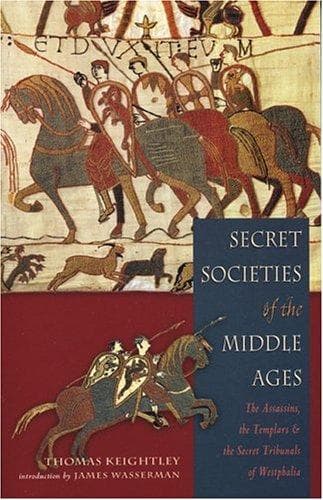
Secret Societies of the Middle AgesKeightley, Thomas
History
Secret Societies of the Middle Ages
Keightley, Thomas
Secret societies
The English historian, Brompton, who wrote in the 12th century, asserts
that the founders of the order of the Temple had originally been members
of that of St. John. We know not what degree of credit this may be
entitled to[70], but it is certain that there had been as yet nothing of
a military character in this last, and that its assumption of such a
character was an imitation of the society of the Temple; for, urged by
the praise which they saw lavished on the Templars for their meritorious
conduct, the Hospitallers resolved to add the task of protecting to that
of tending and relieving pilgrims, and such of their members as were
knights resumed their arms, joyful to employ them once more in the cause
of God. The amplitude of their revenues enabled them to take a number of
knights and footmen into their pay--a practice in which they had
probably been preceded by the Templars, who thus employed the money
which was remitted to them from Europe. But during the lifetime of
Raymond Dupuy the order of the Hospital did not become completely a
military one; he always bore the simple title of director
(_procurator_) of the Hospital, and it was not till some time afterwards
that the head of the society was, like that of the Templars, styled
master, and led its troops to battle. At all times the tendence of the
poor and the sick formed a part of the duties of the brethren of the
Hospital, and this was always a marked distinction between them and the
rival order of the Temple, whose only task was that of fighting against
the infidels.
[Footnote 70: The other writers of that century agree in the account
given above. Brompton's authority has been preferred by some modern
writers, who probably wished to pay their court to the order of Malta.]
[Illustration]
During the first nine years which elapsed after the institution of their
order the knights of the Temple lived in poverty, religiously devoting
all the money which was sent to them from Europe to the advantage of the
Holy Land, and the service of pilgrims. They had no peculiar habit,
their raiment was such as the charity of the faithful bestowed upon
them; and though knights, and engaged in constant warfare against the
infidels, their poverty and moderation were such that Hugh des Payens
and his companion, Godfrey, of St. Omer, had but one war-horse between
them--a circumstance which they afterwards, in their brilliant period,
commemorated by their seal, which represented two knights mounted on the
one horse, a device chosen with a view to inculcating humility on the
brethren, now beginning to wax haughty and insolent.
Public-domain text, read in full here on John Shaqi.
Reviews
Reviews
No reviews yet
Be the first to share your thoughts on this work.
Elsewhere in the archive
Join the Discussion
Join the discussion
Sign in to leave a comment or review.
Sign InorCreate an account