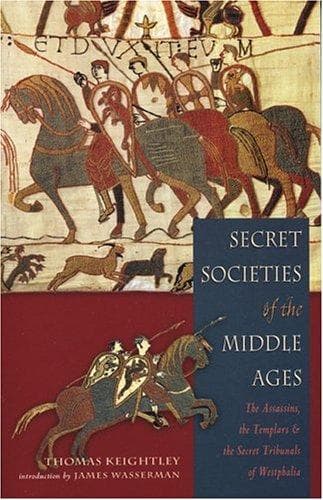
Secret Societies of the Middle AgesKeightley, Thomas
History
Secret Societies of the Middle Ages
Keightley, Thomas
Secret societies
A chief cause of the extraordinary success of the first Crusaders had
been the want of union among their enemies. The Saracens and Turks
mutually hated each other, and would not combine for a common object,
and the Turks were, moreover, at enmity among themselves, and one prince
frequently allied himself with the Christians against another. But they
were now beginning to perceive the necessity of union, and were becoming
every day more formidable to their Christian neighbours. King Baldwin
II., who had been a prisoner in their hands, made every effort when he
had obtained his freedom to strengthen his kingdom, and, among other
means for this purpose, he resolved to gain for the Templars, whose
valour, humility, and single-mindedness were the theme of general
applause, additional consideration, by obtaining from the Holy Father
the confirmation of their order. With this view he despatched, in the
year 1127, two of their members, named Andreas and Gundemar, to Rome,
with this request to the Pope, to whom they were also to make a strong
representation of the perilous state of the Holy Land. The king,
moreover, furnished them with a letter of recommendation to St. Bernard,
Abbot of Clairvaux, whose influence was then all-powerful in the
Christian world, and who was nephew of the envoy Andreas. Shortly
afterwards Hugh de Payens himself arrived in Europe with five others of
the brethren.
Nothing could be more advantageous to the new order than the favour and
countenance of the illustrious Abbot of Clairvaux, who had been for some
time past an admirer of its objects and deeds. Three years before this
time he had written a letter to the Count of Champagne, who had entered
the order of the Templars, praising the act as one of eminent merit in
the sight of God. He now, on occasion of the visit of the Master[71],
wrote, at his request, an eloquent work, exhorting the brethren of the
new order to persevere in their toilsome but highly laudable task of
fighting against the tyranny of the heathens, and commending their piety
to the attention of all the faithful, setting in strong opposition to
the luxury of the knights of his time the modesty and simplicity of
these holy warriors. He extolled the unlimited obedience of the Templars
to their Master, both at home and in the field. "They go and come," says
he, "at a sign from their Master; they wear the clothing which he gives
them, and ask neither food nor clothing from any one else; they live
cheerfully and temperately together, without wives and children, and,
that nothing may be wanting for evangelical perfection, without
property, in one house, endeavouring to preserve the unity of the spirit
in the bond of peace, so that one heart and one soul would appear to
dwell in them all. They never sit idle, or go about gaping alter news.
When they are resting from warfare against the infidels, a thing which
rarely occurs, not to eat the bread of idleness, they employ themselves
Public-domain text, read in full here on John Shaqi.
Reviews
Reviews
No reviews yet
Be the first to share your thoughts on this work.
Elsewhere in the archive
Join the Discussion
Join the discussion
Sign in to leave a comment or review.
Sign InorCreate an account