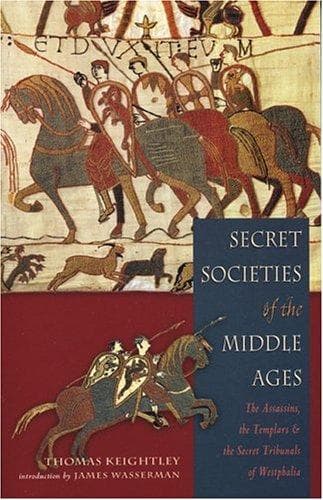
Secret Societies of the Middle AgesKeightley, Thomas
History
Secret Societies of the Middle Ages
Keightley, Thomas
Secret societies
in repairing their clothes and arms, or do something which the command
of the Master or the common need enjoins. There is with them no respect
of persons; the best, not the noblest, are the most highly regarded;
they endeavour to anticipate one another in respect and to lighten each
other's burdens. No unseemly word or light mocking, no murmur or
immoderate laughter, is let to pass unreproved, if any one should allow
himself to indulge in such. They avoid games of chess and tables; they
are adverse to the chase, and equally so to hawking, in which others so
much delight. They hate all jugglers and mountebanks, all wanton songs
and plays, as vanities and follies of this world. They cut their hair in
obedience to these words of the apostle, 'it is not seemly in a man to
have long hair;' no one ever sees them dressed out; they are seldom ever
washed; they are mostly to be seen with disordered hair, and covered
with dust, brown from their corslets and the heat of the sun. When they
go forth to war they arm themselves within with faith, without with
iron, but never adorn themselves with gold, wishing to excite fear in
the enemy, and not the desire of booty. They delight in horses which are
strong and swift, not in such as are handsomely marked and richly
caparisoned, wishing to inspire terror rather than admiration. They go
not impetuously and headlong into battle, but with care and foresight,
peacefully, as the true children of Israel. But as soon as the fight has
begun, then they rush without delay on the foes, esteeming them but as
sheep; and know no fear, even though they should be few, relying on the
aid of the Lord of Sabaoth. Hence one of them has often put a thousand,
and two of them ten thousand, to flight. Thus they are, in union
strange, at the same time gentler than lambs and grimmer than lions, so
that one may doubt whether to call them monks or knights. But both names
suit them, for theirs is the mildness of the monk and the valour of the
knight. What remains to be said but that this is the Lord's doing, and
it is wonderful in our eyes? Such are they whom God has chosen out of
the bravest in Israel, that, watchful and true, they may guard the holy
sepulchre, armed with swords, and well skilled in war."
[Footnote 71: Wilken I. 28, gives 1135 as the year in which this piece
was written.]
Though in these expressions of St. Bernard there may be perceived some
marks of rhetorical exaggeration, they prove incontestibly the high
character and sincere virtue of the founders of the society of the
Templars, and that it was organized and regulated with none but worthy
objects in view. They also offer, if such were required, an additional
proof that the crusade was no emanation of chivalry; for those to whom
St. Bernard throughout sets the Templars in opposition were the chivalry
of the age.
Public-domain text, read in full here on John Shaqi.
Reviews
Reviews
No reviews yet
Be the first to share your thoughts on this work.
Elsewhere in the archive
Join the Discussion
Join the discussion
Sign in to leave a comment or review.
Sign InorCreate an account