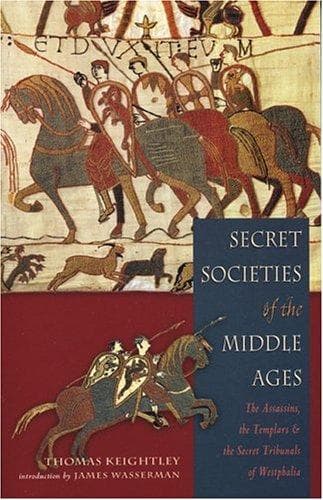
Secret Societies of the Middle AgesKeightley, Thomas
History
Secret Societies of the Middle Ages
Keightley, Thomas
Secret societies
This epistle of the Abbot of Clairvaux had been circulated, and every
other just and honest mean employed to conciliate the public favour for
the Templars, when, on the 31st January, 1128, the Master, Hugh de
Payens, appeared before the council of Troyes, consisting of the
Archbishops of Rheims and Sens, ten bishops, and a number of abbots,
among whom was St. Bernard himself, and presided over by the Cardinal of
Albano, the papal legate. The Master having given an account of the
principles and exploits of the Templars, the assembled fathers approved
of the new order, and gave them a new rule, containing their own
previous regulations, with several additions drawn from that of the
Benedictines, and chiefly relating to spiritual matters. The validity of
this rule was made to depend on the approbation of it by the Holy Father
and by the Patriarch of Jerusalem, neither of whom hesitated to confirm
it. By the direction of the Pope Honorius, the synod appointed a white
mantle to be the distinguishing dress of the brethren of the Temple,
that of those of the Hospital being black. This mantle was plain,
without any cross, and such it remained till the pontificate of Pope
Eugenius III., who, in 1146, appointed the Templars to wear a _red_
cross on the breast, as a symbol of the martyrdom to which they stood
constantly exposed: the cross worn on their black mantles, by the
knights of St. John, was, as we have seen[72], _white_. The order now
assumed, or were assigned, a peculiar banner, formed of cloth, striped
black and white, called in old French, _Bauseant_[73], which word became
the battle-cry of the knights of the Temple, and often struck terror
into the hearts of the infidels. It bore on it the ruddy cross of the
order, and the pious and humble inscription, _Non nobis, Domine, non
nobis, sed nomini tuo, da gloriam_, (Not to us, O Lord, not to us, but
to thy name give the glory!)
[Footnote 72: _See_ p. 187. Sir W. Scott describes his Templar in
Ivanhoe, as wearing a white mantle with a _black_ cross of eight points.
The original cross of the Hospitallers, we may observe, had not eight
points. That of the order of Malta was of this form.]
[Footnote 73: _Bauseant_, or _Bausant_, was, in old French, a piebald
horse, or a horse marked white and black. Ducange, Roquefort. The word
is still preserved with its original meaning in the Scotch dialect, in
the form _Bawsent_:
"His honest, sonsie, baws'nt face
Aye gat him friends in ilka place,"
says Burns, describing the "ploughman's collie," in his tale of the "Twa
Dogs;" and in the Glossary, Dr. Currie explains _Baws'nt_ as meaning
"having a white stripe down the face." As, however, some notion of
handsomeness or attractiveness of appearance seems to be involved in the
epithet, _Bauseant_, or _Beauséant_, may possibly be merely an older
form of the present French word, _Bienséant_.]
Public-domain text, read in full here on John Shaqi.
Reviews
Reviews
No reviews yet
Be the first to share your thoughts on this work.
Elsewhere in the archive
Join the Discussion
Join the discussion
Sign in to leave a comment or review.
Sign InorCreate an account