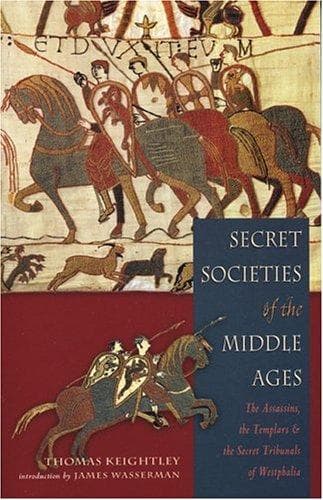
Secret Societies of the Middle AgesKeightley, Thomas
History
Secret Societies of the Middle Ages
Keightley, Thomas
Secret societies
The office of treasurer of the order was always united with the dignity
of preceptor of the kingdom of Jerusalem. This officer had the charge of
all the receipts and expenditure of the order, of which he was bound to
give an account, when required, to the Master and the chapter. The
wardrobe of the order was also under him; and the draper was assigned as
his companion, without whose knowledge he could not dispose of any of
the clothes. As the ships, though few in number, which the Templars
possessed, were under him, he may be regarded as, also, in some sort,
the admiral of the order; and on this account the preceptor of Acre was
subordinate to him. The treasurer had the same allowance of horses, &c.
as the seneschal.
The draper had charge of the clothing of the order: he was to see that
each brother was decently and properly dressed. His allowance was four
horses, two esquires, and a pack-servant.
The Turcopilar was the commander of the light horse. All the armed
serving-brethren and the Turcopoles were under his command. He was
himself subordinate to the marshal. When he was going into action, some
of the knights were sent with him. These were under his orders; but if
their number amounted to ten, and they had with them a banner and a
knight-preceptor, the Turcopilar became subordinate to this officer;
which proves that the office of Turcopilar was not one of the higher
dignitaries of the order. The Turcopilar was allowed four horses.
Besides these offices of the order in the East, there were the
great-priors, great-preceptors, or provincial-masters (for the terms are
synonymous) of the three provinces of Jerusalem, Tripolis, and Antioch;
and the preceptors, who were subordinate to them.
The great-prior of the kingdom of Jerusalem was also treasurer. His
office has been already noticed. The great-priors of Tripolis and
Antioch had the superintendence over the brethren and the possessions of
the order in these provinces. They had the same allowances of attendants
and horses as the seneschal. The prior of Antioch, when on a journey to
Armenia, which bordered on his province, and in which the order had
possessions, was allowed to take with him a chaplain and a portable
chapel, as the Armenians were monophysite heretics, with whom the
orthodox brethren of the Temple could not join in worship.
The prior of the town of Jerusalem had peculiar duties to perform. It
was his office, with ten knights who stood under his command, to escort
the pilgrims on their way to and from the Jordan--one of the principal
objects of the institution of the order. On this occasion he had with
him the banner of the order and a round tent, into which he might take
any persons whom he should find sick when he encamped: he was also to
take with him provisions, and beasts of burden on which to place such of
the pilgrims as might be fatigued on the return.
Public-domain text, read in full here on John Shaqi.
Reviews
Reviews
No reviews yet
Be the first to share your thoughts on this work.
Elsewhere in the archive
Join the Discussion
Join the discussion
Sign in to leave a comment or review.
Sign InorCreate an account