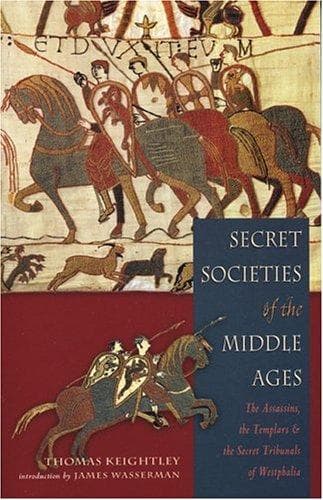
Secret Societies of the Middle AgesKeightley, Thomas
History
Secret Societies of the Middle Ages
Keightley, Thomas
Secret societies
In the intervals between the meetings of general chapters, the powers of
the order were exercised by the chapter of the Temple at Jerusalem. This
was composed of the Master, the dignitaries of the order, such of the
provincial masters as happened to be present, the two assistants of the
Master, and such knights as he chose to invite to it. This last
provision was the great source of the Master's power; and, when he was a
man of talent and address, he could, by managing to get his friends and
those whom he could depend on into the different offices, and by
summoning to the chapter such knights as were attached or looked up to
him, contrive to carry any matters that he desired. The laws, however,
by way of check upon him, made it imperative that the high officers of
the order should have seats in the chapter; and as these were not
appointed by the Master, and were independent of him, it was supposed
that they would not be his creatures. This chapter could decide on all
matters relating to the order, some important affairs, such as war and
peace, excepted; make laws and regulations, which were binding on the
whole society; and send visitors to the different provinces. All public
documents, such as papal bulls, were addressed to it and the Master; all
decisions in matters of importance came from it; and all the brethren
who were received in the West were sent to it to be distributed where
they might be wanting. The declaration made by a French knight on his
examination, that the receptions in the chapter of Jerusalem were rare,
as the members could be seldom brought to agree respecting a candidate,
gives a hint that it was not in general a scene of the greatest harmony
and unity. It is, indeed, but natural to suppose, that, as it was the
chief seat of the power of the order, it was also the great theatre of
intrigue and cabal.
Each province of the order had its general chapter, and also a smaller
one, presided over by the great-prior, and composed of the principal
officers and such knights of character and estimation as the prior chose
to call to it. In like manner every preceptory and every large house of
the order had its chapter, at which all the brethren were required to
attend. The commander was president, and each question was decided by
the majority of voices. The chief transactions in it consisted in the
reception of new brethren, and the making up of quarrels and disputes,
which must have frequently fallen out among men like the Templars, who
were almost all soldiers. It was holden early on a Sunday morning; and
the strictest secrecy, as to what took place, was enjoined on all
present, for _secrecy was the soul of the order_.
Public-domain text, read in full here on John Shaqi.
Reviews
Reviews
No reviews yet
Be the first to share your thoughts on this work.
Elsewhere in the archive
Join the Discussion
Join the discussion
Sign in to leave a comment or review.
Sign InorCreate an account