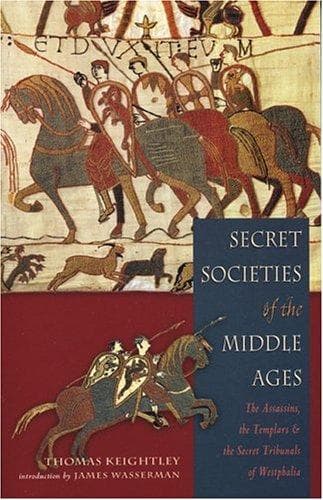
Secret Societies of the Middle AgesKeightley, Thomas
History
Secret Societies of the Middle Ages
Keightley, Thomas
Secret societies
[Footnote 7: See, in Sir J. Malcolm's History of Persia, the dialogue
between the Persian king Yezdijird and the Arab envoy. "Whatever," said
the latter, "thou hast said regarding the former condition of the Arabs
is true. Their food was green lizards; they buried their infant
daughters alive; nay, some of them feasted on dead carcasses and drank
blood, while others slew their relations, and thought themselves great
and valiant when, by such an act, they became possessed of more
property. They were clothed with hair garments, knew not good from evil,
and made no distinction between that which is lawful and that which is
unlawful. Such was our state. But God in his mercy has sent us by a holy
prophet a sacred volume, which teaches us the true faith," &c.]
[Footnote 8: Hallam, Middle Ages, ii. 165.]
Such is a slight sketch of the religion which Mohammed substituted for
the idolatry of Arabia. It contained little that was original; all its
details of the future state were borrowed from Judaism or from the
Magian system of Persia. The book which contains it, entitled the Koran
(_reading_), was composed in detached pieces, during a long series of
years, by the _illiterate_ Prophet, and taken down from his lips by his
scribes. His own account of its origin was that each Sura, or
revelation, was brought to him from heaven by the angel Gabriel. It is
regarded by the Mohammedan East, and by most European Orientalists, as
the masterpiece of Arabian literature; and when we make due allowance
for the difference of European and Arabian models and taste, and
consider that the rhyme[9] which in prose is insufferable to the former,
may to the latter sound grateful, we may allow that the praises lavished
on it are not unmerited. Though tedious and often childish legends, and
long and tiresome civil regulations, occupy the greater part of it, it
is pervaded by a fine strain of fervid piety and humble resignation to
the will of God, not unworthy of the inspired seers of Israel; and the
sublime doctrine of the Unity of God runs like a vein of pure gold
through each portion of the mass, giving lustre and dignity to all.
Might we not venture to say that Christianity itself has derived
advantage from the imposture of Mohammed, and that the clear and open
profession of the Divine Unity by their Mohammedan enemies kept the
Christians of the dark ages from smothering it beneath the mass of
superstition and fable by which they corrupted and deformed so much of
the majestic simplicity of the Gospel? No one, certainly, would dream of
comparing the son of Abd-Allah with the Son of God, of setting darkness
by the side of light; but still we may confess him to have been an agent
in the hands of the Almighty, and admit that his assumption of the
prophetic office was productive of good as well as of evil.
Public-domain text, read in full here on John Shaqi.
Reviews
Reviews
No reviews yet
Be the first to share your thoughts on this work.
Join the Discussion
Join the discussion
Sign in to leave a comment or review.
Sign InorCreate an account