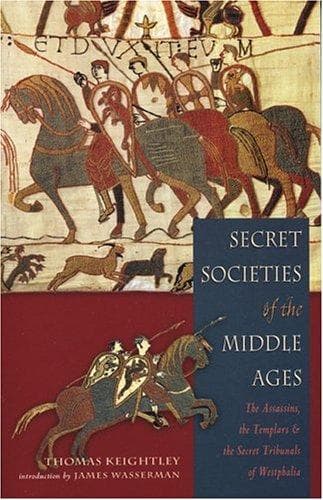
Secret Societies of the Middle AgesKeightley, Thomas
History
Secret Societies of the Middle Ages
Keightley, Thomas
Secret societies
[Footnote 9: The Hebrews, as appears from the poetic parts of the
Scriptures, had the same delight in the clang of rhyme as the Arabs. See
particularly Isaiah in the original.]
The Mohammedan religion is so intimately connected with history, law,
manners, and opinions, in the part of the East of which we are about to
write, that this brief view of its origin and nature was indispensable.
We now proceed to our history.
CHAPTER II.
Origin of the Khalifat--The first Khalifs--Extent of the Arabian
Empire--Schism among the Mohammedans--Soonees and Sheähs--Sects of
the latter--The Keissanee--The Zeidites--The Ghoollat--The
Imamee--Sects of the Imamee--Their political Character--The
Carmathites--Origin of the Fatimite Khalifs--Secret Society at
Cairo--Doctrines taught in it--Its Decline.
The civil and ecclesiastical dignities were united in the person of
Mohammed. As Emir (_prince_) he administered justice and led his
followers to battle; as Imam (_director_) he on every Friday (the
Mohammedan sabbath) taught the principles and duties of religion from
his pulpit. Though his wives were numerous, the Prophet had no male
issue surviving at the time when he felt the approaches of death; but
his daughter Fatima was married to his cousin Ali, his early and
faithful disciple, and it was naturally to be expected that the expiring
voice of the Prophet would nominate him as his Khalif (_successor_) over
the followers of his faith. But Ayesha, the daughter of Aboo Bekr,
Mohammed's youthful and best beloved wife, was vehemently hostile to the
son of Aboo Talib, and she may have exerted all the influence of a
revengeful woman over the mind of the dying Prophet. Or perhaps
Mohammed, like Alexander, perplexed with the extent of dominion to which
he had attained, and aware that only a vigour of character similar to
his own would avail to retain and enlarge it, and, it may be, thinking
himself answerable to God for the choice he should make, deemed it the
safest course to leave the matter to the free decision of his surviving
followers. His appointing Aboo Bekr, a few days before his death, to
officiate in his pulpit, might seem to indicate an intention of
conferring the khalifat on him; and he is said to have at one time
declared that the strength of character displayed by his distinguished
follower, Omar, evinced his possession of the virtues of a prophet and a
khalif. Tradition records no equally strong declaration respecting the
mild and virtuous Ali.
Public-domain text, read in full here on John Shaqi.
Reviews
Reviews
No reviews yet
Be the first to share your thoughts on this work.
Join the Discussion
Join the discussion
Sign in to leave a comment or review.
Sign InorCreate an account