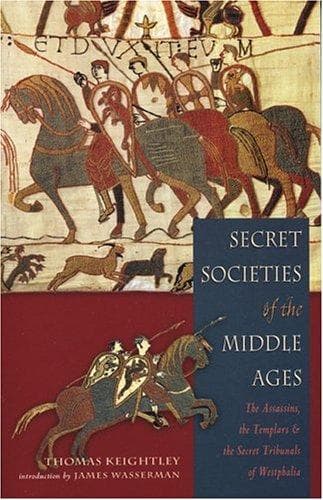
Secret Societies of the Middle AgesKeightley, Thomas
History
Secret Societies of the Middle Ages
Keightley, Thomas
Secret societies
The Arabian empire was now of immense extent. Egypt, Syria, and Persia
had been conquered in the reign of Omar. Under the first khalifs of the
dynasty of the Ommiades (so called from Ommiyah, the great-grandfather
of Moawiya), the conquest of Africa and Spain was achieved, and the
later princes of this family ruled over the most extensive empire of the
world.
The great schism of the Mohammedan church (we must be permitted to
employ this term, the only one our language affords) commences with the
accession of the house of Ommiyah. The Mohammedans have, as is generally
known, been from that time to the present day divided into two great
sects, the Soonees and the Sheähs, the orthodox and the dissenters, as
we might venture to call them, whose opposite doctrines, like those of
the Catholics and the Protestants of the Christian church, are each the
established faith of great and independent nations. The Ottoman and the
Usbeg Turks hold the Soonee faith; the Persians are violent Sheähs; and
national and religious animosity concur in making them the determined
and inveterate foes of each other.
The Soonees hold that the first four khalifs were all legitimate
successors of the Prophet; but as their order was determined by their
degree of sanctity, they assign the lowest rank to Ali. The Sheähs, on
the contrary, maintain that the dignity of the Prophet rightfully
descended to the son of his uncle and the husband of his daughter. They
therefore regard Aboo Bekr, Omar, and Othman, as usurpers, and curse and
revile their memory, more especially that of the rigid Omar, whose
murderer they venerate as a saint. It must be steadily kept in mind, in
every discussion respecting the Mohammedan religion, that Mohammed and
his successors succeeded in establishing what the lofty and capacious
mind of Gregory VII. attempted in vain--the union of the civil and
ecclesiastical powers in the same person. Unlike the schisms of the
eastern and western, of the Catholic and Protestant churches, which
originated in difference of opinion on points of discipline or matters
of doctrine, that of the Mohammedans arose solely from ambition and the
struggle for temporal power. The sceptre of the greatest empire of the
world was to be the reward of the party who could gain the greatest
number of believers in his right to grasp the staff and ascend the
pulpit of the Prophet of God. Afterwards, when the learning of the
Greeks and the Persians became familiar to the Arabs, theological and
metaphysical niceties and distinctions were introduced, and the two
great stems of religion threw out numerous sectarian branches. The
Soonees are divided into four main sects, all of which are, however,
regarded as orthodox, for they agree in the main points, though they
differ in subordinate ones. The division of the Sheähs is also into four
sects, the point of agreement being the assertion of the right of Ali
and his descendants to the imamat, or supreme ecclesiastical dignity;
Public-domain text, read in full here on John Shaqi.
Reviews
Reviews
No reviews yet
Be the first to share your thoughts on this work.
Join the Discussion
Join the discussion
Sign in to leave a comment or review.
Sign InorCreate an account