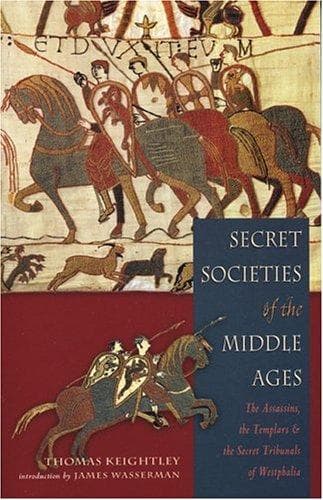
Secret Societies of the Middle AgesKeightley, Thomas
History
Secret Societies of the Middle Ages
Keightley, Thomas
Secret societies
At all events the Prophet expired without having named a successor, and
the choice devolving on his companions dissension was ready to break
out, when Omar, abandoning his own claims, gave his voice for Aboo Bekr.
All opposition was thus silenced, and the father of Ayesha reigned for
two years over the faithful. Ali at first refused obedience, but he
finally acknowledged the successor of the Prophet. When dying, Aboo Bekr
bequeathed the sceptre to Omar, as the worthiest, and when, twelve years
afterwards, Omar perished by the dagger of an assassin, six electors
conferred the vacant dignity on Othman, who had been the secretary of
the Prophet. Age having enfeebled the powers of Othman, the reins of
authority were slackened, and a spirit of discord pervaded all Arabia,
illustrative of the Prophet's declaration of vigour being essential to a
khalif. A numerous body of rebels besieged the aged Othman in Medina,
and he was slain, holding the Koran in his lap, by a band of murderers,
headed by the brother of Ayesha, who, the firebrand of Islam, it is
probable had been secretly active in exciting the rebellion.
The popular choice now fell upon Ali, but the implacable Ayesha
stimulated to revolt against his authority two powerful Arab chiefs,
named Telha and Zobeir, who raised their standards in the province of
Arabian Irak. Ayesha, mounted on a camel, appeared in the thickest of
the battle, in which the rebel chiefs were defeated and slain. The
generous Ali sent her to dwell at the tomb of the Prophet, where she
passed in tranquillity the remainder of her days. The khalif himself was
less fortunate. Moawiya, the Governor of Syria, son of Aboo Sofian, the
most violent of the opponents of the Prophet, assumed the office of the
avenger of Othman, whose death he charged on Ali and his party, and,
declaring himself to be the rightful khalif, roused Syria to arms
against the Prophet's son-in-law. In the war success was on the side of
Ali, till the superstition of his troops obliged him to agree to a
treaty; and shortly afterwards he was murdered by a fanatic in the mosk
of Coofa. His son Hassan was induced by Moawiya to resign his claims and
retire to the city of Medina; but his more high-spirited brother,
Hussein, took arms against the khalif Yezid, the son of Moawiya; and the
narrative of his death is one of the most pathetic and best related
incidents of Oriental history[10]. The sisters and children of Hussein
were spared by the clemency of the victorious Yezid, and from them
descend a numerous race, glorying in the blood of Ali and the Prophet.
[Footnote 10: See Ockley's History of the Saracens.]
Public-domain text, read in full here on John Shaqi.
Reviews
Reviews
No reviews yet
Be the first to share your thoughts on this work.
Join the Discussion
Join the discussion
Sign in to leave a comment or review.
Sign InorCreate an account