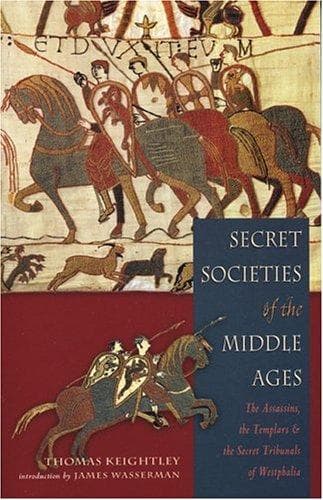
Secret Societies of the Middle AgesKeightley, Thomas
History
Secret Societies of the Middle Ages
Keightley, Thomas
Secret societies
The history of the Fehm-gerichte, previous to the fifteenth century,
offers but few events to detain attention. The Emperor Lewis the
Bavarian appears to have exerted his authority on several occasions in
granting privileges in Westphalia according, as it is expressly stated,
to the Fehm-law. His successor, the luxurious Charles IV., acted with
the same caprice respecting the Fehm-tribunals as he did in every thing
else, granting privileges and revoking them just as it seemed to accord
with his interest at the moment. This monarch attempted also to extend
the Fehm-system beyond Westphalia, deeming it perhaps a good mean for
bringing all Germany under the authority of his patrimonial kingdom of
Bohemia. He therefore gave permission to the Bishop of Hildesheim to
erect two Free-tribunals out of Westphalia. On the representations of
the Archbishop of Cologne and the lords of Westphalia, however, he
afterwards abolished them.
Wenceslaus, the son of Charles, acted with his usual folly in the case
of the Fehm-tribunals; he is said, as he could keep nothing secret, to
have blabbed their private sign, and he took on him to make
frei-schöppen, contrary to the law, out of Westphalia. These schöppen of
the emperor's making did not, however, meet with much respect from the
genuine ones, as the answer given to the Emperor Rupert by the
Westphalian tribunals evinces. On his asking how they acted with regard
to such schöppen, their reply was, "We ask them at what court they were
made schöppen. Should it appear that they were made schöppen at courts
which had no right so to do, we hang them, in case of their being met in
Westphalia, on the instant, without any mercy." Wenceslaus, little as he
cared about Germany in general, occasionally employed the Fehm-courts
for the furtherance of his plans, and, in the year 1389, he had Count
Henry of Wernengerode tried and hanged for treason by Westphalian
schöppen. The reign of Wenceslaus is particularly distinguished by its
being the period in which the Archbishop of Cologne arrived at the
important office of lieutenant of the emperor over all the Westphalian
tribunals.
The reign of Rupert was, with respect to the Westphalian Fehm-courts,
chiefly remarkable by the reformation of them named from him. This
reformation, which is the earliest publicly-accredited source from which
a knowledge of the Fehm-law can be derived, was made in the year 1404.
It is a collection of decisions by which the rights and privileges of a
king of the Romans are ascertained with respect to these tribunals.
Public-domain text, read in full here on John Shaqi.
Reviews
Reviews
No reviews yet
Be the first to share your thoughts on this work.
Elsewhere in the archive
Join the Discussion
Join the discussion
Sign in to leave a comment or review.
Sign InorCreate an account