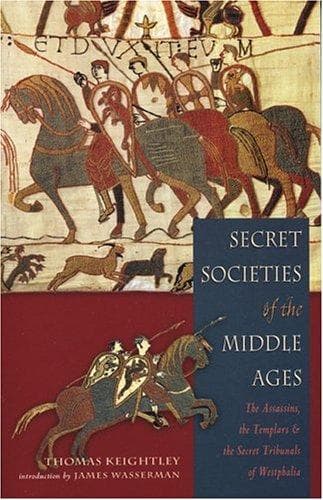
Secret Societies of the Middle AgesKeightley, Thomas
History
Secret Societies of the Middle Ages
Keightley, Thomas
Secret societies
III. The Ghoollat (_Ultras_), so named from the extravagance of their
doctrines, which, passing all bounds of common sense, were held in equal
abomination by the other Sheähs and by the Soonees. This sect is said to
have existed as early as the time of Ali himself, who is related to have
burnt some of them on account of their impious and extravagant
opinions. They held, as we are told, that there was but one imam, and
they ascribed the qualities of divinity to Ali. Some maintained that
there were two natures (the divine and the human) in him, others that
the last alone was his. Some again said that this perfect nature of Ali
passed by transmigration through his descendants, and would continue so
to do till the end of all things; others that the transmission stopped
with Mohammed Bakir, the son of Zein-al-Abedeen, who still abode on
earth, but unseen, like Khizer, the Guardian of the Well of Life,
according to the beautiful eastern legend[13]. Others, still more bold,
denied the transmission, and asserted that the divine Ali sat enthroned
in the clouds, where the thunder was the voice and the lightning the
scourge wherewith he terrified and chastised the wicked. This sect
presents the first (though a very early) instance of the introduction
into Islam of that mysticism which appears to have had its original
birth-place in the dreamy groves of India. As a political party the
Ghoollat never seem to have been formidable.
[Footnote 13: Khizer, by some supposed, but perhaps erroneously, to be
the prophet Elias, is regarded by the Mohammedans in the light of a
beneficent genius. He is the giver of youth to the animal and the
vegetable world. He is clad in garments of the most brilliant green, and
he stands as keeper of the Well of Life in the Land of Darkness.
According to the romances of the East, Iskander, that is, Alexander the
Great, resolved to march into the West, to the Land of Darkness, that he
might drink of the water of immortality. During seven entire days he and
his followers journeyed through dark and dismal deserts. At length they
faintly discerned in the distance the green light which shone from the
raiment of Khizer. As they advanced it became more and more resplendent,
like the brightest and purest emeralds. As the monarch approached,
Khizer dipped a cup in the verdant Water of Life, and reached it to him;
but the impatience of Iskander was so great that he spilt the contents
of the cup, and the law of fate did not permit the guardian of the fount
to fill it for him again. The moral of this tale is evident. Its
historic foundation is the journey of the Macedonian to the temple of
Ammon.]
Public-domain text, read in full here on John Shaqi.
Reviews
Reviews
No reviews yet
Be the first to share your thoughts on this work.
Join the Discussion
Join the discussion
Sign in to leave a comment or review.
Sign InorCreate an account