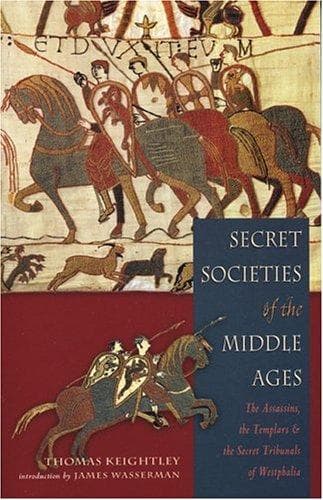
Secret Societies of the Middle AgesKeightley, Thomas
History
Secret Societies of the Middle Ages
Keightley, Thomas
Secret societies
IV. Such, however, was not the case with the Imamee, the most dangerous
enemies of the house of Abbas. Agreeing with the Ghoollat in the
doctrine of an _invisible_ imam, they maintained that there had been a
series of _visible_ imams antecedent to him, who had vanished. One
branch of this sect (thence called the Seveners--_Sebiïn_) closed the
series with Ismaïl, the grandson of Mohammed Bakir, the _seventh_ imam,
reckoning Ali himself the first. These were also called Ismaïlites, from
Ismaïl. The other branch, called Imamites, continued the series from
Ismaïl, through his brother Moosa Casim, down to Askeree, the twelfth
imam. These were hence called the Twelvers (_Esnaashree_). They believed
that the imam Askeree had vanished in a cavern at Hilla, on the banks of
the Euphrates, where he would remain invisible till the end of the
world, when he would again appear under the name of the Guide (_Mehdee_)
to lead mankind into the truth. The Imamee, wherever they might stop in
the series of the visible imams, saw that, for their political purposes,
it was necessary to acknowledge a kind of _locum tenentes_ imams; but,
while the Zeidites, who agreed with them in this point, required in
these princes the royal virtues of valour, generosity, justice,
knowledge, the Imamee declared themselves satisfied if they possessed
the saintly ones of the practice of prayer, fasting, and alms-giving.
Hence artful and ambitious men could set up any puppet who was said to
be descended from the last of the visible imams, and aspire to govern
the Mohammedan world in his name.
The Twelvers were very near obtaining possession of the khalifat in the
time of the first Abbassides; for the celebrated Haroon Er-Rasheed's
son, Al-Mamoon, the eighth khalif of that house, moved either by the
strength or preponderance which the Sheäh party had arrived at, or, as
the eastern historians tell us, yielding to the suggestions of his
vizir, who was devoted to that sect, named Ali Riza, the eighth imam, to
be his successor on the throne. He even laid aside the black habiliments
peculiar to his family, and wore green, the colour of Ali and the
Prophet. But the family of Abbas, which now numbered 30,000 persons,
refused their assent to this renunciation of the rights of their line.
They rose in arms, and proclaimed as khalif Al-Mamoon's uncle Ibrahim.
The obnoxious vizir perished, and the opportune death of Ali Riza (by
poison, as was said) relieved the son of Haroon Er-Rasheed from
embarrassment. Ali Riza was interred at Meshed, in the province of
Khorasan; and his tomb is, to the present day, a place of pilgrimage for
devout Persians[14].
[Footnote 14: See Frazer's Khorasan.]
The Ismaïlites were more successful in their attempts at obtaining
temporal power; and, as we shall presently see, a considerable portion
of their dominions was wrested from the house of Abbas.
Public-domain text, read in full here on John Shaqi.
Reviews
Reviews
No reviews yet
Be the first to share your thoughts on this work.
Join the Discussion
Join the discussion
Sign in to leave a comment or review.
Sign InorCreate an account