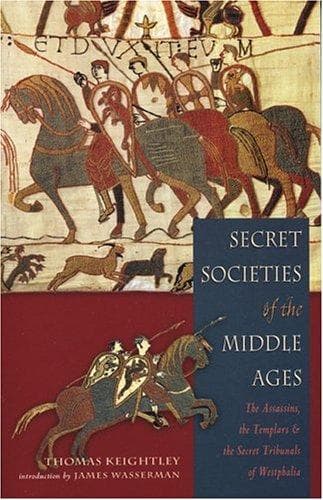
Secret Societies of the Middle AgesKeightley, Thomas
History
Secret Societies of the Middle Ages
Keightley, Thomas
Secret societies
revolt against the house of Abbas. But, be this as it may, on surveying
the early centuries of Islam, we may observe that all the rebellions
which agitated the empire of the khalifs arose from a union of the
claims of the family of Ali with the philosophical doctrines current in
Persia.
We are told that, in the ninth century of the Christian era, Abdallah, a
man of Persian lineage, residing at Ahwaz, in the south of Persia,
conceived the design of overturning the empire of the khalifs by
secretly introducing into Islam a system of atheism and impiety. Not to
shock deep-rooted prejudices in favour of the established religion and
government, he resolved to communicate his doctrines gradually, and he
fixed on the mystic number seven as that of the degrees through which
his disciples should pass to the grand revelation of the vanity of all
religions and the indifference of all actions. The political cloak of
his system was the assertion of the claims of the descendants of
Mohammed, the son of Ismaïl, to the imamat, and his missionaries
(_dais_) engaged with activity in the task of making proselytes
throughout the empire of the khalifs. Abdallah afterwards removed to
Syria, where he died. His son and grandsons followed up his plans, and
in their time a convert was made who speedily brought the system into
active operation[16].
[Footnote 16: Macrisi is Hammer's authority for the preceding account of
Abdallah. It is to be observed that this Abdallah is unnoticed by
Herbelot.]
The name of this person was Carmath, a native of the district of Koofa,
and from him the sect was called Carmathites. He made great alterations
in the original system of Abdallah; and as the sect was now grown
numerous and powerful, he resolved to venture on putting the claims of
the descendants of Ismaïl to the test of the sword. He maintained that
the indefeasible right to earthly dominion lay with what he styled the
imam Maässoom (_spotless_), a sort of ideal of a perfect prince, like
the wise man of the Stoics; consequently all the reigning princes were
usurpers, by reason of their vices and imperfections; and the warriors
of the perfect prince were to precipitate them all, without distinction,
from their thrones. Carmath also taught his disciples to understand the
precepts and observances of Islam in a figurative sense. Prayer
signified obedience to the imam Maässoom, alms-giving was paying the
tithe due to him (that is, augmenting the funds of the society), fasting
was keeping the political secrets relating to the imam and his service.
It was not the tenseel, or outward word of the Koran, which was to be
attended to; the taweel, or exposition, was alone worthy of note. Like
those of Mokanna, and other opponents of the house of Abbas, the
followers of Carmath distinguished themselves by wearing white raiment
to mark their hostility to the reigning khalifs, whose garments and
standards retained the black hue which they had displayed against the
Public-domain text, read in full here on John Shaqi.
Reviews
Reviews
No reviews yet
Be the first to share your thoughts on this work.
Join the Discussion
Join the discussion
Sign in to leave a comment or review.
Sign InorCreate an account