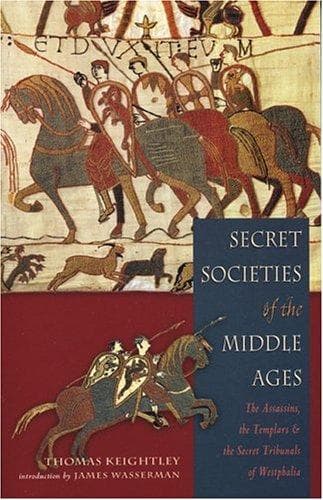
Secret Societies of the Middle AgesKeightley, Thomas
History
Secret Societies of the Middle Ages
Keightley, Thomas
Secret societies
white banners of the house of Ommiyah. A bloody war was renewed at
various periods during an entire century between the followers of
Carmath and the troops of the khalifs, with varying success. In the
course of this war the holy city of Mecca was taken by the sectaries (as
it has been of late years by the Wahabees), after the fall of 30,000
Moslems in its defence. The celebrated black stone was taken and
conveyed in triumph to Hajar, where it remained for two-and-twenty
years, till it was redeemed for 50,000 ducats by the emir of Irak, and
replaced in its original seat. Finally, like so many of their
predecessors, the Carmathites were vanquished by the yet vigorous power
of the empire, and their name, though not their principles, was
extinguished.
During this period of contest between the house of Abbas and the
Carmathites, a dai (_missionary_) of the latter, named Abdallah,
contrived to liberate from the prison into which he had been thrown by
the khalif Motadhad a real or pretended descendant of Fatima, named
Obeid-Allah[17], whom he conveyed to Africa, and, proclaiming him to be
the promised Mehdi (_guide_), succeeded in establishing for him a
dominion on the north coast of that country. The gratitude of
Obeid-Allah was shown by his putting to death him to whom he was
indebted for his power; but talent and valour can exist without the
presence of virtue, and Obeid-Allah and his two next descendants
extended their sway to the shores of the Atlantic. Moez-ladin-Allah, his
great-grandson, having achieved the conquest of Egypt and Syria, wisely
abandoned his former more distant dominions along the coast of the
Mediterranean, his eye being fixed on the more valuable Asiatic empire
of the Abbassides. This dynasty of Fatimite khalifs, as they were
called, reigned during two centuries at Cairo, on the Nile, the foes and
rivals of those who sat in Bagdad, on the banks of the Tigris. Like
every other eastern dynasty, they gradually sank into impotence and
imbecility, and their throne was finally occupied by the renowned Koord
Saladin.
[Footnote 17: The genuineness of the descent of Obeid-Allah has been a
great subject of dispute among the eastern historians and jurists. Those
in the interests of the house of Abbas strained every nerve to make him
out an impostor.]
Obeid-Allah derived his pedigree from Ismaïl, the seventh imam. His
house, therefore, looked to the support of the whole sect of the
Seveners, or Ismaïlites, in their projects for extending their sway over
the Mohammedan world; and it was evidently their interest to increase
the numbers and power of that sect as much as possible. We are
accordingly justified in giving credit to the assurances of the eastern
historians, that there was a secret institution at Cairo, at the head of
which was the Fatimite khalif, and of which the object was the
dissemination of the doctrines of the sect of the Ismaïlites, though we
may be allowed to hesitate as to the correctness of some of the details.
Public-domain text, read in full here on John Shaqi.
Reviews
Reviews
No reviews yet
Be the first to share your thoughts on this work.
Join the Discussion
Join the discussion
Sign in to leave a comment or review.
Sign InorCreate an account