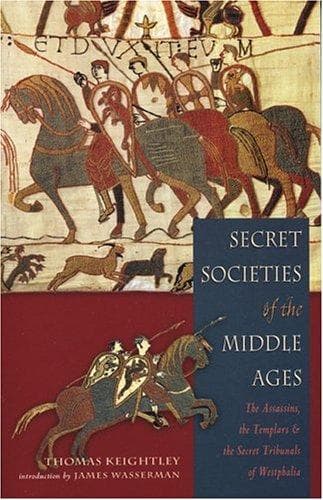
Secret Societies of the Middle AgesKeightley, Thomas
History
Secret Societies of the Middle Ages
Keightley, Thomas
Secret societies
that mystic Pantheism which is held and taught by the sect of the
Soofees. 8. The positive precepts of religion were again considered, the
veil was torn from the eyes of the aspirant, all that had preceded was
now declared to have been merely scaffolding to raise the edifice of
knowledge, and was to be flung down. Prophets and teachers, heaven and
hell, all were nothing; future bliss and misery were idle dreams; all
actions were permitted. 9. The ninth degree had only to inculcate that
nought was to be believed, everything might be done[21].
[Footnote 20: Hammer, p. 54.]
[Footnote 21: Mr. De Sacy (_Journal des Savans_, an 1818) is of opinion
that the Arabic words _Taleel_ and _Ibahat_ will not bear the strong
sense which Hammer gives them. The former, he says, only signifies that
Deism which regards the Deity as merely a speculative being, and
annihilates the moral relations between him and the creature; the latter
only denotes emancipation from the positive precepts of laws, such as
fasting, prayer, &c., but not from moral obligations.]
In perusing the accounts of secret societies, their rules, regulations,
degrees, and the quantity or nature of the knowledge communicated in
them, a difficulty must always present itself. Secrecy being of the very
essence of everything connected with them, what means had writers, who
were generally hostile to them, of learning their internal constitution
and the exact nature of their maxims and tenets? In the present case our
authority for this account of a society which chiefly flourished in the
tenth and eleventh centuries is Macrisi, a writer of the fifteenth
century. His authorities were doubtless of more ancient date, but we
know not who they were or whence they derived their information. Perhaps
our safest course in this, as in similar cases, would be to admit the
general truth of the statement, but to suffer our minds to remain in a
certain degree of suspense as to the accuracy of the details. We can
thus at once assent to the fact of the existence of the college at
Cairo, and of the mystic tenets of Soofeeism being taught in it, as also
to that of the rights of the Fatimites to the khalifat being inculcated
on the minds of the pupils, and missionaries being thence sent over the
east, without yielding implicit credence to the tale of the nine degrees
through which the aspirant had to pass, or admitting that the course of
instruction terminated in a doctrine subversive of all religion and of
all morality.
Public-domain text, read in full here on John Shaqi.
Reviews
Reviews
No reviews yet
Be the first to share your thoughts on this work.
Join the Discussion
Join the discussion
Sign in to leave a comment or review.
Sign InorCreate an account