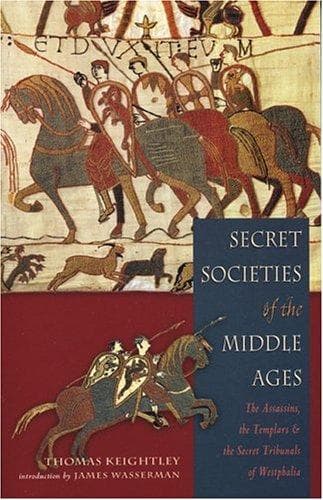
Secret Societies of the Middle AgesKeightley, Thomas
History
Secret Societies of the Middle Ages
Keightley, Thomas
Secret societies
As we have seen, the Dai-al-doat, or chief missionary, resided at Cairo,
to direct the operations of the society, while the subordinate dais
pervaded all parts of the dominions of the house of Abbas, making
converts to the claims of Ali. The dais were attended by companions
(_Refeek_), who were persons who had been instructed up to a certain
point in the secret doctrines, but who were neither to presume to teach
nor to seek to make converts, that honour being reserved to the dais. By
the activity of the dais the society spread so widely that in the year
1058 the emir Bessassiri, who belonged to it, made himself master of
Bagdad, and kept possession of it during an entire year, and had money
struck, and prayer made, in the name of the Egyptian khalif. The emir,
however, fell by the sword of Toghrul the Turk, whose aid the feeble
Abbasside implored, and these two distinguishing acts of Mohammedan
sovereignty were again performed by the house of Abbas. Soon afterwards
the society at Cairo seems to have declined along with the power of the
Fatimite khalifs. In 1123 the powerful vizir Afdhal, on occasion of some
disturbance caused by them, shut up the Dar-al-hicmet, or, as it would
appear, destroyed it. His successor Mamoon permitted the society to hold
their meetings in a building erected in another situation, and it
lingered on till the fall of the khalifat of Egypt. The policy of Afdhal
is perhaps best to be explained by a reference to the state of the East
at that time. The khalif of Bagdad was become a mere pageant devoid of
all real power; the former dominions of the house of Abbas were in the
hands of the Seljookian Turks; the Franks were masters of a great part
of Syria, and threatened Egypt, where the khalifs were also fallen into
incapacity, and the real power had passed to the vizir. As this last
could aspire to nothing beyond preserving Egypt, a society instituted
for the purpose of gaining partisans to the claims of the Fatimites must
have been rather an impediment to him than otherwise. He must therefore
have been inclined to suppress it, especially as the society of the
Assassins, a branch of it, had now been instituted, which, heedless of
the claims of the Fatimites, sought dominion for itself alone. To the
history of that remarkable association we now proceed.
CHAPTER III.
Ali of Rei--His son Hassan Sabah--Hassan sent to study at
Nishaboor--Meets there Omar Khiam and Nizam-al-Moolk--Agreement
made by them--Hassan introduced by Nizam to Sultan Malek
Shah--Obliged to leave the Court--Anecdote of him--His own account
of his Conversion--Goes to Egypt--Returns to Persia--Makes himself
Master of Alamoot.
Public-domain text, read in full here on John Shaqi.
Reviews
Reviews
No reviews yet
Be the first to share your thoughts on this work.
Join the Discussion
Join the discussion
Sign in to leave a comment or review.
Sign InorCreate an account