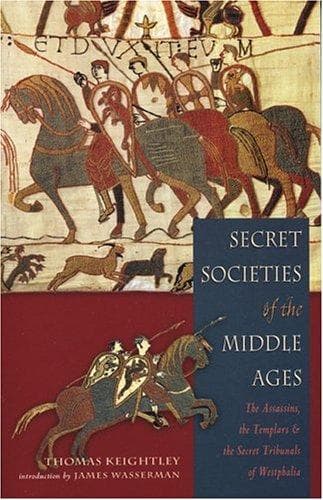
Secret Societies of the Middle AgesKeightley, Thomas
History
Secret Societies of the Middle Ages
Keightley, Thomas
Secret societies
There was a man named Ali, who resided in the city of Rei, in Persia. He
was a strenuous Sheäh, and maintained that his family had originally
come from Koofa, in Arabia; but the people of Khorasan asserted that his
family had always dwelt in one of the villages near Toos, in that
province, and that consequently his pretensions to an Arabian extraction
were false. Ali, it would appear, was anxious to conceal his opinions,
and employed the strongest asseverations to convince the governor of the
province, a rigid Soonite, of his orthodoxy, and finally retired into a
monastery to pass the remainder of his days in meditation. As a further
means of clearing himself from the charge of heresy he sent his only son
Hassan Sabah[22] to Nishaboor to be instructed by the celebrated imam
Mowafek, who resided at that place. What lessons he may have given the
young Hassan previously to parting with him, and what communication he
may have afterwards kept up with him, are points on which history is
silent.
[Footnote 22: Or Hassan-ben-Sabah (_son of Sabah_), so named from Sabah
Homairi, one of his pretended Arabian ancestors.]
The fame of the imam Mowafek was great over all Persia, and it was
currently believed that those who had the good fortune to study the
Koran and the Soonna[23] under him were secure of their fortune in
after-life. His school was consequently thronged by youths ambitious of
knowledge and future distinction; and here Hassan met, and formed a
strict intimacy with, Omar Khiam, afterwards so distinguished as a poet
and an astronomer, and with Nizam-al-Moolk (_Regulation of the Realm_),
who became vizir to the monarchs of the house of Seljook. This last, in
a history which he wrote of himself and his times, relates the following
instance of the early development of the ambition of Hassan. As these
three, who were the most distinguished pupils of the imam, were one day
together, "It is the general opinion," said Hassan, "that the pupils of
the imam are certain of being fortunate. This opinion may be verified in
one of us. So come, let us pledge ourselves to one another that he who
shall be successful will make the other two sharers in his good
fortune." His two companions readily assented, and the promise was
mutually given and received.
[Footnote 23: The Soonna is the body of traditions, answering to the
Mishua of the Jews, held by the orthodox Mussulmans.]
Public-domain text, read in full here on John Shaqi.
Reviews
Reviews
No reviews yet
Be the first to share your thoughts on this work.
Join the Discussion
Join the discussion
Sign in to leave a comment or review.
Sign InorCreate an account