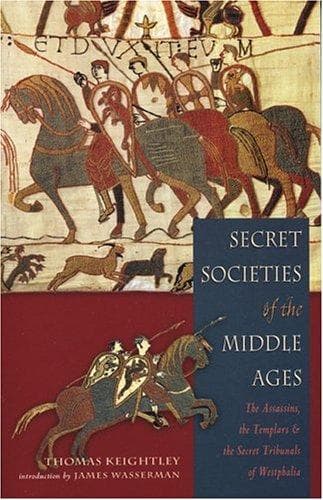
Secret Societies of the Middle AgesKeightley, Thomas
History
Secret Societies of the Middle Ages
Keightley, Thomas
Secret societies
confusion, the sultan became enraged at the apparent attempt to deceive
him, and Hassan was forthwith obliged to retire from court with
precipitation.
Nizam-al-Moolk determined to keep no measures with a man who had thus
sought his ruin, and he resolved to destroy him. Hassan fled to Rei,
but, not thinking himself safe there, he went further south, and took
refuge with his friend the reis[24] Aboo-'l-Fazl (_Father of
Excellence_), at Isfahan. What his plans may have hitherto been is
uncertain; but now they seem to have assumed a definite form, and he
unceasingly meditated on the means of avenging himself on the sultan and
his minister. In consultation one day with Aboo-'l-Fazl, who appears to
have adopted his speculative tenets, after he had poured out his
complaints against the vizir and his master, he concluded by
passionately saying, "Oh that I had but two faithful friends at my
devotion! soon should I overthrow the Turk and the peasant," meaning the
sultan and the vizir. Aboo-'l-Fazl, who was one of the most clear-headed
men of his time, and who still did not comprehend the long-sighted views
of Hassan, began to fancy that disappointment had deranged the intellect
of his friend, and, believing that reasoning would in such a case be
useless, commenced giving him at his meals aromatic drinks and dishes
prepared with saffron, in order to relieve his brain. Hassan perceived
what his kind host was about, and resolved to leave him. Aboo-'l-Fazl in
vain employed all his eloquence to induce him to prolong his visit;
Hassan departed, and shortly afterwards set out for Egypt.
[Footnote 24: _Reis_, from the Arabic Râs (_the head_), answers in some
respects to _captain_, a word of similar origin. Thus the master of a
shin is called the Reis. Sir John Malcolm says, "it is equivalent to
_esquire_, as it was originally understood. It implies in Persia the
possession of landed estates and some magisterial power. The reis is in
general the hereditary head of a village."]
Twenty years afterwards, when Hassan had accomplished all he had
projected, when the sultan and the vizir were both dead, and the society
of the Assassins was fully organized, the reis Aboo-'l-Fazl, who was one
of his most zealous partisans, visited him at his hill-fort of Alamoot.
"Well, reis," said Hassan, "which of us was the madman? did you or I
stand most in need of the aromatic drinks and the dishes prepared with
saffron which you used to have served up at Isfahan? You see that I kept
my word as soon as I had found two trusty friends."
Public-domain text, read in full here on John Shaqi.
Reviews
Reviews
No reviews yet
Be the first to share your thoughts on this work.
Join the Discussion
Join the discussion
Sign in to leave a comment or review.
Sign InorCreate an account