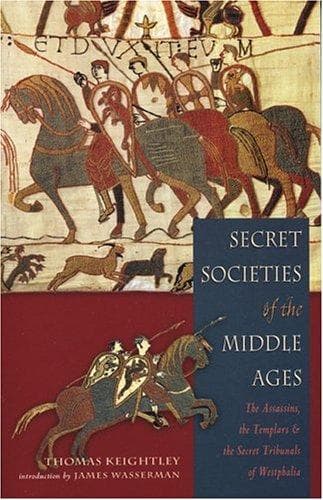
Secret Societies of the Middle AgesKeightley, Thomas
History
Secret Societies of the Middle Ages
Keightley, Thomas
Secret societies
When Hassan left Isfahan, in the year 1078, the khalif Mostanser, a man
of some energy, occupied the throne of Egypt, and considerable exertions
were made by the missionaries of the society at Cairo to gain proselytes
throughout Asia. Among these proselytes was Hassan Sabah, and the
following account of his conversion, which has fortunately been
preserved in his own words, is interesting, as affording a proof that,
like Cromwell, and, as we have supposed, Mohammed, and all who have
attained to temporal power by means of religion, he commenced in
sincerity, and was deceived himself before he deceived others.
"From my childhood," says he, "even from the age of seven years, my sole
endeavour was to acquire knowledge and capacity. I had been reared up,
like my fathers, in the doctrine of the twelve imams, and I made
acquaintance with an Ismaïlite companion (_Refeek_), named Emir Dhareb,
with whom I knit fast the bonds of friendship. My opinion was that the
tenets of the Ismaïlites resembled those of the Philosophers, and that
the ruler of Egypt was a man who was initiated in them. As often,
therefore, as Emir said anything in favour of these doctrines I fell
into strife with him, and many controversies on points of faith ensued
between him and me. I gave not in to anything that Emir said in
disparagement of our sect, though it left a strong impression on my
mind. Meanwhile Emir parted from me, and I fell into a severe fit of
sickness, during which I reproached myself, saying, that the doctrine of
the Ismaïlites was assuredly the true one, and that yet out of obstinacy
I had not gone over to it, and that should death (which God avert!)
overtake me, I should die without having attained to the truth. At
length I recovered of that sickness, and I now met with another
Ismaïlite, named Aboo Nejm Zaraj, of whom I inquired touching the truth
of his doctrine. Aboo Nejm explained it to me in the fullest manner, so
that I saw quite through the depths of it. Finally I met a dai, named
Moomin, to whom the sheikh Abd-al-Melik (_Servant of the King_, i. e.
_of God_) Ben Attash, the director of the missions of Irak, had given
permission to exercise this office. I besought that he would accept my
homage (in the name of the Fatimite khalif), but this he at the first
refused to do, because I had been in higher dignities than he; but when
I pressed him thereto beyond all measure, he yielded his consent. When
now the sheikh Abd-al-Melik came to Rei, and through intercourse learned
to know me, my behaviour was pleasing unto him, and he bestowed on me
the office of a dai. He said unto me, 'Thou must go unto Egypt, to be a
sharer in the felicity of serving the imam Mostander.' When the sheikh
Abd-al-Melik went from Rei to Isfahan I set forth for Egypt[25]."
[Footnote 25: Mirkhond.]
Public-domain text, read in full here on John Shaqi.
Reviews
Reviews
No reviews yet
Be the first to share your thoughts on this work.
Join the Discussion
Join the discussion
Sign in to leave a comment or review.
Sign InorCreate an account