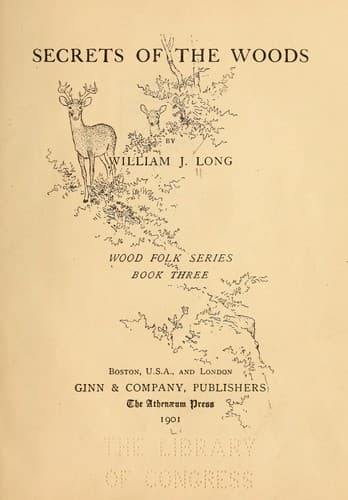
Secrets of the woodsLong, William J. (William Joseph)
History
Secrets of the woods
Long, William J. (William Joseph)
Animal behavior -- Juvenile literature; Natural history -- Juvenile literature; Zoology -- Juvenile literature
When a brood of young partridges hear a dog running in the woods, they
generally flit to the lower branches of a tree and kwit-kwit at him
curiously. They have not yet learned the difference between him and the
fox, who is the ancient enemy of their kind, and whom their ancestors of
the wilderness escaped and tantalized in the same way. But when it is an
old bird that your setter is trailing, his actions are a curious mixture
of cunning and fascination. As old Don draws to a point, the grouse
pulls himself up rigidly by a stump and watches the dog. So both stand
like statues; the dog held by the strange instinct which makes him
point, lost to sight, sound and all things else save the smell in his
nose, the grouse tense as a fiddlestring, every sense alert, watching
the enemy whom he thinks to be fooled by his good hiding. For a few
moments they are motionless; then the grouse skulks and glides to a
better cover. As the strong scent fades from Don's nose, he breaks
his point and follows. The grouse hears him and again hides by drawing
himself up against a stump, where he is invisible; again Don stiffens
into his point, one foot lifted, nose and tail in a straight line, as if
he were frozen and could not move.
So it goes on, now gliding through the coverts, now still as a stone,
till the grouse discovers that so long as he is still the dog seems
paralyzed, unable to move or feel. Then he draws himself up, braced
against a root or a tree boll; and there they stand, within twenty feet
of each other, never stirring, never winking, till the dog falls from
exhaustion at the strain, or breaks it by leaping forward, or till the
hunter's step on the leaves fills the grouse with a new terror that
sends him rushing away through the October woods to deeper solitudes.
Once, at noon, I saw Old Ben, a famous dog, draw to a perfect point.
Just ahead, in a tangle of brown brakes, I could see the head and neck
of a grouse watching the dog keenly. Old Ben's master, to test the
splendid training of his dog, proposed lunch on the spot. We withdrew a
little space and ate deliberately, watching the bird and the dog with an
interest that grew keener and keener as the meal progressed, while Old
Ben stood like a rock, and the grouse's eye shone steadily out of the
tangle of brakes. Nor did either move so much as an eyelid while we ate,
and Ben's master smoked his pipe with quiet confidence. At last, after
a full hour, he whacked his pipe on his boot heel and rose to reach for
his gun. That meant death for the grouse; but I owed him too much of
keen enjoyment to see him cut down in swift flight. In the moment that
the master's back was turned I hurled a knot at the tangle of brakes.
The grouse burst away, and Old Ben, shaken out of his trance by the
whirr of wings, dropped obediently to the charge and turned his head to
say reproachfully with his eyes: "What in the world is the matter with
you back there--didn't I hold him long enough?"
Public-domain text, read in full here on John Shaqi.
Reviews
Reviews
No reviews yet
Be the first to share your thoughts on this work.
Join the Discussion
Join the discussion
Sign in to leave a comment or review.
Sign InorCreate an account